Richard Ansdell
1815–1885 · United Kingdom of Great Britain and Ireland · Romanticism, Academic art
The story
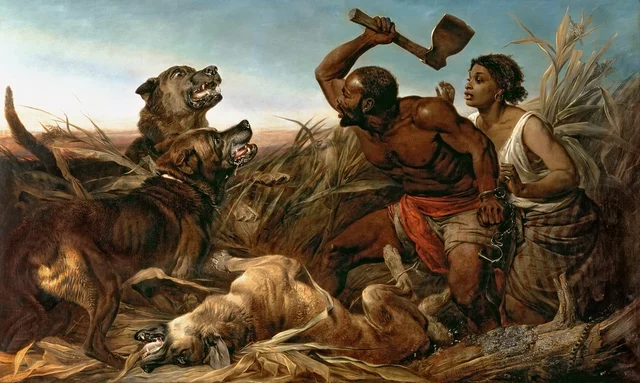
Richard Ansdell showed The Hunted Slaves at the Royal Academy in London in 1861, the year the American Civil War broke out. It shows an escaped couple cornered by a pack of dogs, the man fighting them off to shield his wife, and it was exhibited with lines from a poem by Henry Wadsworth Longfellow, the American poet, about a fugitive slave. Ansdell later gave the painting to a lottery for relief of the Lancashire cotton famine, the hardship that followed when the war cut off American cotton. The winner presented it to the city of Liverpool, and it hangs in the Walker Art Gallery.
The subject was unusual for him. Born in Liverpool in 1815 and schooled at the Blue Coat School, a charity school for orphans, after his father's early death, Ansdell made his career as a painter of animals: sheep, cattle, dogs and game, often in Highland settings. He worked with the landscape painter Thomas Creswick, who supplied the scenery around his animals, and with William Powell Frith, the painter of crowded modern scenes. In 1856 he travelled to Spain with the Scottish painter John Phillip.
He was elected an associate of the Royal Academy in 1861 and a full academician in 1870. He kept a summer house at Lytham on the Lancashire coast, and the district of the town that grew around it is still called Ansdell after him.