Richard Bergh
1858–1919 · Sweden · Symbolism
The story
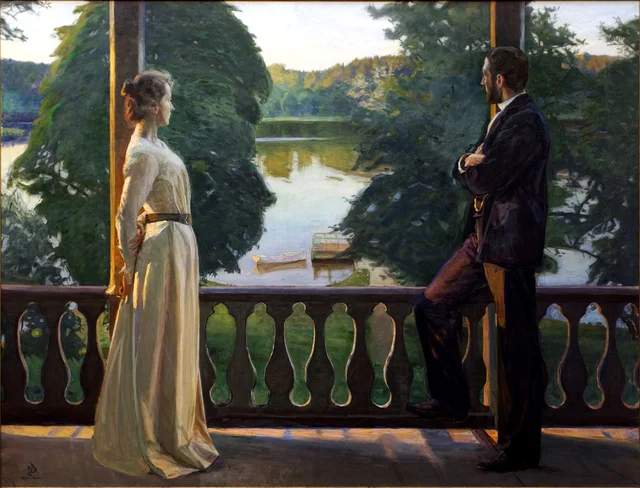
Two figures stand on a veranda in the pale, endless light of a Swedish summer night, gazing out over a still lake, close together and somehow not quite meeting. That painting, Nordic Summer Evening, finished around 1900, is the one most Swedes picture when they hear the name Richard Bergh.
He had learned his light in France. Born in Stockholm in 1858 to two artists, Bergh trained at the Swedish academy and then, like many of his generation, escaped it for the painters' colony at Grez-sur-Loing near Paris, where working out of doors was the rule. In 1885 he joined the Opponents, a group of young Swedish artists who publicly demanded reform of the stiff old academy back home.
In Sweden he turned French open-air painting and a strain of Symbolism into something distinctly national, moody lake landscapes and psychologically charged portraits. In 1915 he was made director of the Nationalmuseum in Stockholm, and he spent his last years reorganising how the national collection was hung and shown, up to his death in 1919.