Rik Wouters
1882–1916 · Belgium · Brabant fauvism
The story
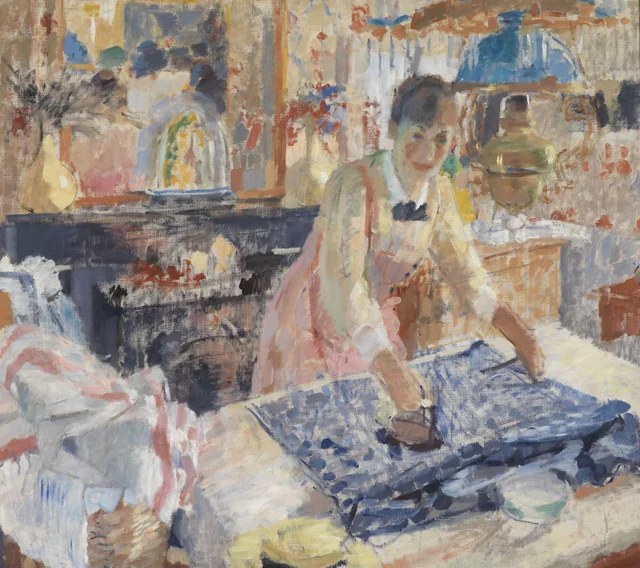
Almost everything Rik Wouters made comes back to one person: Nel, his wife, whom he painted and modelled over and over, reading, sewing, dozing in a chair, ironing in a bright room. He had trained first as an ornamental woodcarver in his father's workshop in Mechelen, north of Brussels, and he carried a carver's feel for weight and movement into loose, sunlit paintings that belong to Belgium's short-lived Fauve moment, all warm colour and quick light.
In 1912 he made the sculpture that carries his name, a bronze he called The Mad Virgin. It shows Nel flung backwards mid-dance, arms thrown wide, caught at the very top of a movement. The pose came from a night in 1907 when the couple watched Isadora Duncan, the American dancer who performed barefoot in loose robes, on a Brussels stage, and five years later Wouters froze that abandon in metal.
He had almost no time. In 1914 the war reached Belgium, Wouters was called up, and after the fall of Antwerp he crossed into the neutral Netherlands and was interned there. Around the same time a cancer took hold in his jaw and eye. He lost the eye, kept working, and died in Amsterdam in 1916, only 33. He left roughly 200 paintings, drawings and sculptures, most of them the record of one ordinary, happy household kept up through the first years of the war.