Rudolf von Alt
1812–1905 · Austrian Empire · Impressionism
The story
In 1897 a group of young Viennese painters led by Gustav Klimt broke away to found the Secession, determined to sweep out everything their fathers had admired. For their honorary president they chose a man of 85: Rudolf von Alt, who had been painting the city in watercolour since before most of them were born.
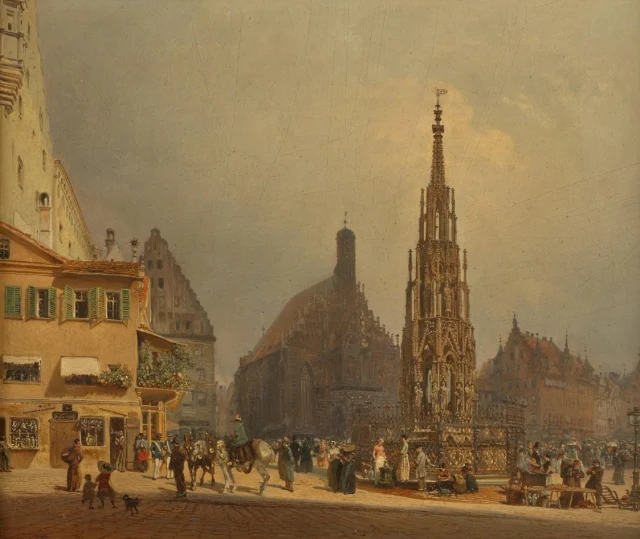
Alt learned the craft from his father, the lithographer Jakob Alt, walking with him through the Alps and northern Italy to study light on stone and water. He built a career on topographically exact views of Vienna, Venice and the wider empire, working the brush so finely that a cathedral front or a crowded square reads almost like a photograph taken before photography was common. He kept at it into his 90s, travelling as far as the Crimea, and left behind more than 5,000 works.
What the Secessionists honoured was his refusal to stiffen. A painter trained in the careful Biedermeier taste of the 1820s had loosened his touch decade by decade until it looked modern to men 60 years younger. He was raised to the nobility in 1889, which is when plain Rudolf Alt could add the 'von' to his name. He died in Vienna in 1905, still working.