Samuel Hirszenberg
1865–1908 · Congress Poland · Realism
The story
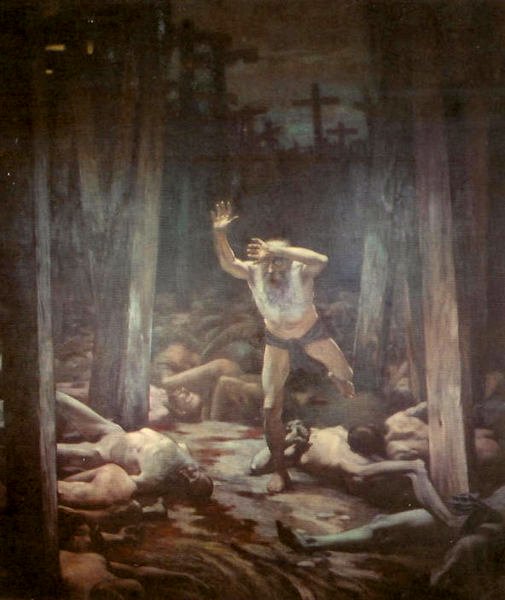
The Wandering Jew, which Samuel Hirszenberg finished in 1899, is more than three metres tall. A naked, wide-eyed old man comes toward the viewer through a field of dead bodies, beneath a row of tall crucifixes. The old Christian legend of a Jew condemned to wander until the end of time becomes here an image of the persecution of Jews in Europe. The canvas hangs today in the Israel Museum in Jerusalem, the city where the painter spent his last year.
Hirszenberg was born in 1865 in Łódź, a fast-growing textile town in the Russian-ruled Kingdom of Poland. His father opposed his becoming an artist, and a doctor helped pay for his studies. At 15 he entered the art school in Kraków, then headed by the history painter Jan Matejko, and later trained in Munich. His early pictures, such as School of Talmudists of 1887 and The Sabbath Rest of 1894, show the life of Jewish towns with a quiet realism.
Around 1900 his work darkened. Exile, of 1904, shows Jewish refugees trudging across snow, and The Black Banner, of 1905, a crowd of Hasidic Jews at a funeral. In 1907 Hirszenberg moved to Jerusalem to teach at the Bezalel school of art, founded there the year before by the sculptor Boris Schatz. He died in Jerusalem in September 1908, aged 43, and one of his last canvases there shows the Dome of the Rock.