School of Anthonis Mor
Habsburg Netherlands · High Renaissance
The story
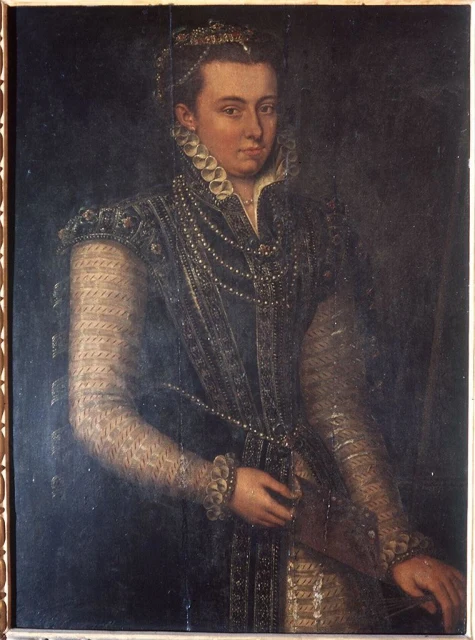
For most of the 20th century a panel in the Galleria Palatina in Florence was a famous picture. A woman sits holding a palette and brushes, and an inscription across the surface carried a name and a date, Lavinia Fontana, 1579, the Bolognese painter who kept a professional workshop and supported a large household on it. The panel was read as her self-portrait. Restoration found that the inscription, the palette and the brushes had all been added long after the picture was painted.
The museum now dates the panel to about 1560 to 1570, gives it to the school of Anthonis Mor, and leaves the sitter unnamed. Scuola di, in the Italian catalogue, means a painter formed in the master's manner and working close to it, a wider net than bottega di, which puts the work in his own rooms.
Mor was the most travelled court portraitist in Europe. Born in Utrecht around 1520 and trained there by Jan van Scorel, he worked for the Habsburgs in Brussels, Lisbon, Madrid and London, where in 1554 he painted Mary Tudor for her Spanish bridegroom Philip. His formula travelled with his pupils, the sitter set against a plain ground, still, richly dressed and giving nothing away. Alonso Sánchez Coello carried it to Madrid, where it fixed the pattern of Spanish royal portraiture for a century. Which painter in which of those countries made the Florence panel has not been settled. The museum's plate still prints the old title, Ritratto di pittrice, portrait of a woman painter.