Simon Maris
1873–1935 · Kingdom of the Netherlands · Amsterdam Impressionism
The story
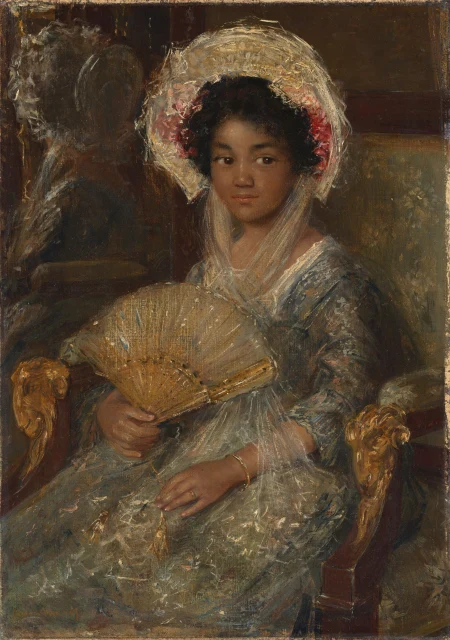
In 1906 a 12-year-old girl sat for Simon Maris in his studio on the Keizersgracht, one of Amsterdam's grand canals. He painted her in a blue and green dress, with a fan in her hand and gold jewellery, in an armchair carved with goats' heads. For decades the picture was catalogued under a title that described her only by the colour of her skin, and later as a young woman with a fan. In 2020, after a letter of 1907 came to light in which Maris himself called her Isabella, the Rijksmuseum gave the painting her name.
Maris grew up among painters. His father Willem Maris, a landscape painter of the Hague School, gave him his first lessons, and his uncles Jacob and Matthijs were painters too. Around 1900 he settled in Amsterdam and became close friends with Piet Mondrian, the future painter of grids and primary colours, who was then still painting quiet riverside landscapes. In 1903 the two travelled together to Spain. Back home they worked side by side along the Gein, a small river outside the city, and in 1906 Maris drew Mondrian's portrait. He also dealt in pictures, Mondrian's among them.
His own path led to portraits. Maris became a sought-after painter of elegant women, fast and fluent with the brush, and critics sometimes called him superficial for it. His wife Cornelia, whom he married in 1908, sat for him too, and the couple spent their summers at Zandvoort, where he painted beach scenes.