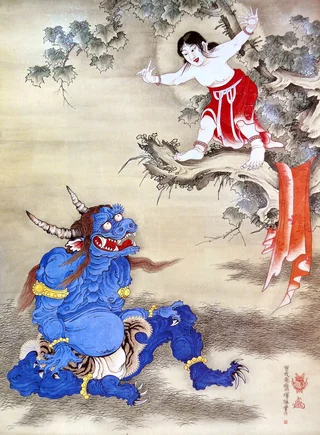
Soga Shōhaku
1730–1781 · Japan · Unkoku school
The story
In Kyoto in the 1760s and 1770s the fashionable painter was Maruyama Ōkyo, whose carefully observed birds, flowers and puppies were drawn straight from life. Soga Shōhaku had no patience with that. A remark attributed to him has outlived them both: if you want a painting, come to me, and if all you need is a drawing, go to Ōkyo.
He was born in 1730, probably in Kyoto, into a merchant family named Miura, and took the name Soga for himself, tying his work to the Soga painters of the 15th century and their rough, forceful ink, long out of style by his day. He trained in the Kanō tradition, the official school of the time, and then went his own way. He spent long stretches in Ise province, south-east of Kyoto, painting for temples and local patrons. His Chinese sages and Daoist immortals have leering, almost grotesque faces, his landscapes bristle with jagged rock, and his ink is splashed and dragged at a speed that still looks reckless.
After his death in 1781 he dropped out of the story of Japanese art almost completely. The historian Tsuji Nobuo brought him back in 1970 with a book called Lineage of Eccentrics, which set him beside Itō Jakuchū and a handful of other painters long written off as oddities. A sizeable group of his paintings had left Japan generations earlier, bought in the 1880s by the Boston collector William Sturgis Bigelow. In 2017 the Museum of Fine Arts in Boston showed them next to new work by the contemporary artist Takashi Murakami, in an exhibition made together with Tsuji himself.
