Stefano Ussi
1822–1901 · Kingdom of Italy · History painting, Orientalism
The story
The first national exhibition of the new Italian kingdom opened in Florence in 1861, and the picture people talked about showed a riot from 1343, the Florentines driving out Walter of Brienne, a French nobleman styled Duke of Athens whom they had invited in to govern them the year before. Stefano Ussi had worked on it for years. It took the exhibition's top prize, and in 1867 it won a gold medal at the world's fair in Paris.
Ussi was 39 in 1861 and had come to the subject the hard way. He trained at the Florence academy, fought in the 1848 war against Austria and was taken prisoner, and came back to a city where a painting of medieval Florence expelling a foreign ruler read very plainly while Italy was being put together. A few streets from his studio, at the Caffè Michelangiolo, younger painters were giving up exactly this kind of canvas for small studies of light. Ussi stayed with the large machine.
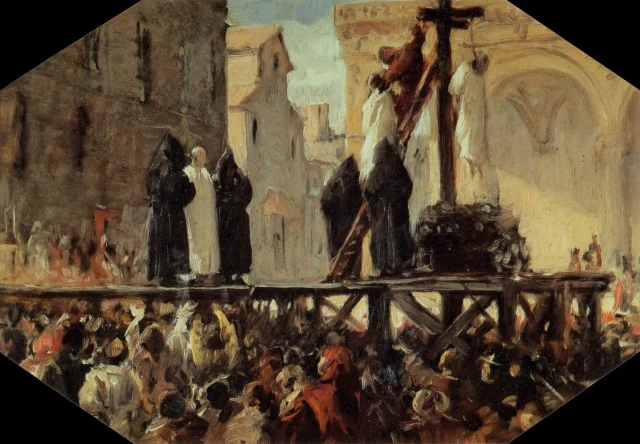
Then he changed continents. He went to Egypt in 1869 for the opening of the Suez Canal, returned in 1872 at the Khedive's invitation, and in 1875 travelled to Morocco with an Italian diplomatic mission, alongside the painter Cesare Biseo and the writer Edmondo De Amicis, who made a book out of the journey. Arab riders and market scenes occupied the rest of his working life. An early idea of his survives in the modern gallery at the Pitti: an octagonal sketch painted on glass around 1850, Savonarola burning in Piazza della Signoria with the Loggia dei Lanzi at the right.