Stephanos Tzangarolas
Republic of Venice · Cretan School, Heptanese School
The story
When Candia, the Venetian capital of Crete, fell to the Ottoman army in 1669 after a siege of 21 years, the painting workshops of the island lost their base, and much of that tradition carried on in the Ionian islands, which Venice still held. Stephanos Tzangarolas belongs to that afterlife. His family were Cretan nobles who had settled on Corfu, and the earliest work recorded for him is in the church of the Holy Trinity there, in 1680.
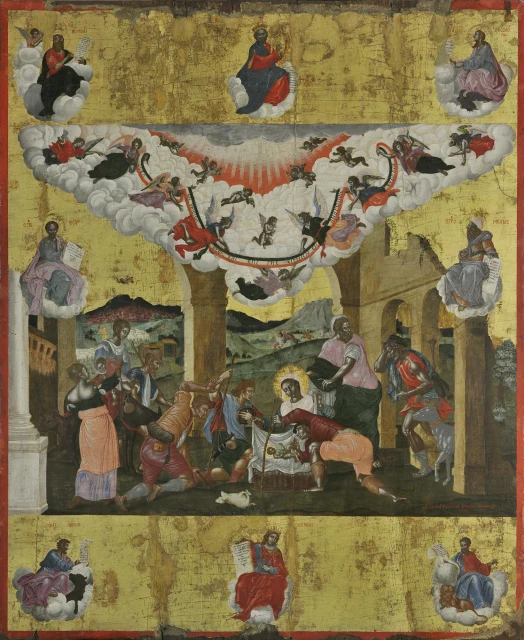
He was a churchman as well as a painter, a deacon by 1688 and ordained priest in 1700, and he signed his icons, which is why historians can follow his hand at all. What the signature sits on is often a Western composition: the Adoration of the Shepherds now in Athens takes four of its prophets from an engraving by the Netherlandish printmaker Cornelis Cort, after a fresco by the Italian painter Federico Zuccari in Rome, and works them in greys that imitate the look of a print.
Nobody knows the year he was born or the year he died. The dates you sometimes see, 1660 to 1710, are conventions of the literature. His pupil Andreas Karantinos went on painting on Corfu after him. The one firm end point for Tzangarolas himself is a Presentation of the Virgin dated 1710, the last picture he signed.