Taddeo di Bartolo
1422 · Republic of Siena · Sienese school
The story
Step into the Collegiate Church of San Gimignano, the Tuscan hill town of stone towers, and the back wall hits you with a Last Judgment. On one side rows of the saved, on the other a Hell so detailed that the damned are labelled by their sins, with devils tearing into the greedy and the proud. Taddeo di Bartolo painted it in the years around 1410, and it is one of the most graphic visions of punishment to survive from the Italian Middle Ages.
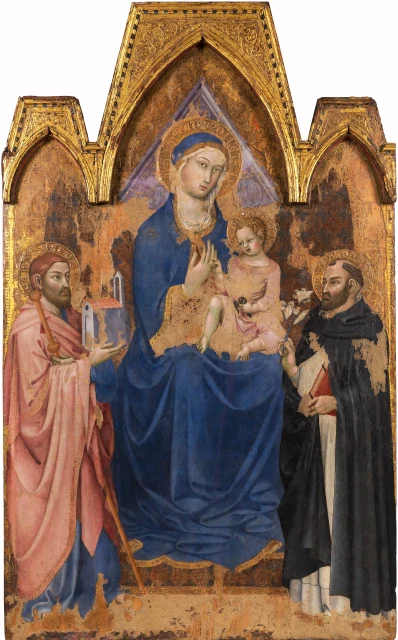
He was a Sienese painter, trained in the glowing, gold-ground style of his city at a moment when nearby Florence was pulling art in a newer, more solid direction. Taddeo kept faith with the older Sienese manner of bright colour, elegant line and saints on fields of gold, and carried it across Tuscany on commission.
He was, in a sense, the end of a line, the last major Sienese master to work in San Gimignano before the town turned to Florentine painters instead. His Hell is still there on the wall, its inscriptions still legible, warning a congregation that has not sat beneath it for 600 years.