Thomas Couture
1815–1879 · France · Academic art
The story
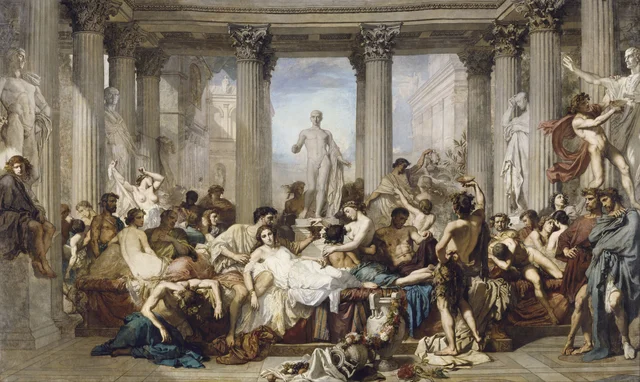
Thomas Couture had one enormous success and one enormous influence, and they pulled in opposite directions. In 1847 he unveiled a vast canvas at the Paris Salon, Romans of the Decadence, a hall of beautiful Romans sprawled in exhaustion after a night of pleasure, a moral warning dressed as a feast. It was the sensation of the year and made him famous across France.
He set up a teaching studio on the strength of it, and that is where his real mark was made. Among his pupils was the young Édouard Manet, who spent six restless years with him. The two argued constantly, the master defending polished classical finish, the student pushing toward the flat, modern, loosely brushed painting that would help launch Impressionism.
Couture himself never repeated the triumph of 1847. Proud and difficult, he quarrelled with the official art world, left Paris, and spent his later years teaching and writing about technique in the countryside, dying in 1879 as the movement his own student had helped start swept the ground from under him.