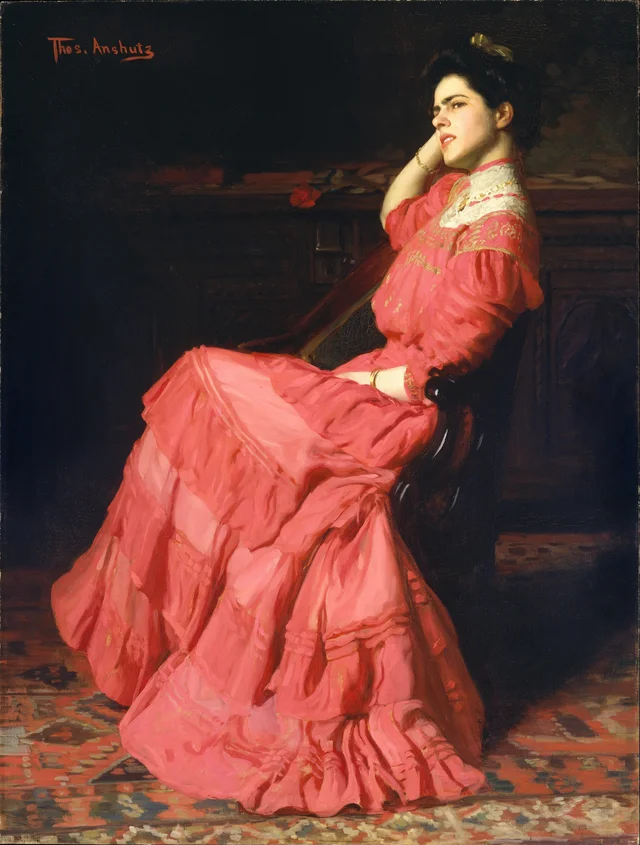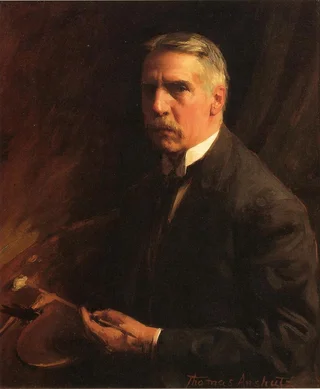
Thomas Pollock Anshutz
1851–1912 · United States · Realism, American Impressionism
The story
In 1880, a 29-year-old student at the Pennsylvania Academy in Philadelphia finished a small painting of ironworkers on their lunch break, twenty-odd men washing, stretching, and resting in a foundry yard near Wheeling, on the Ohio River where he had grown up. American painters of the day reached for landscapes and portraits, and almost no one thought a shift of laborers was worth a canvas. The Ironworkers' Noontime did, and it is now read as one of the first serious American paintings of industrial work.
Anshutz had come to Philadelphia to study with Thomas Eakins, the demanding realist who ran the Academy's classes, and he soon became Eakins's assistant. When Eakins was forced out in 1886 over his insistence on working from the fully nude model, Anshutz stayed and inherited the teaching.
That is where his real mark lies. For three decades he trained the artists who would become the next generation of American painting: Robert Henri, John Sloan, and George Luks of the gritty Ashcan school, and the modernists Charles Sheeler, Charles Demuth, and John Marin. He kept painting quietly to the end, though it was the teaching that shaped what came after. He died in 1912, the year before the Armory Show brought European modern art crashing into New York.