Tito Conti
1842–1924 · Grand Duchy of Tuscany, Kingdom of Italy · Academic art, Historical genre painting
The story
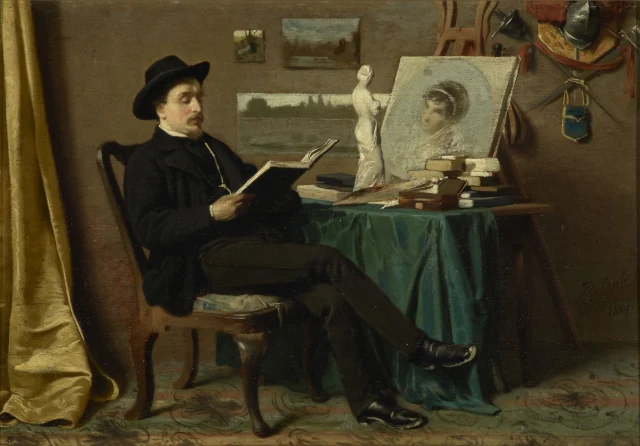
A small canvas in the modern art gallery at Palazzo Pitti shows a man in a painter's studio, legs crossed, absorbed in a book, a table piled with books beside him, a sketched canvas on the easel, landscapes on the walls and old weapons hanging at the right. Across the right side, in cursive, Tito Conti wrote that it was for his friend Dumini, and the year, 1867. He was 25.
Conti was born in Florence in 1842 and entered the Accademia di Belle Arti there at 13. He started where an ambitious young painter was supposed to start, with history, showing a Christopher Columbus subject at the first national exhibition in 1861 and then scenes from the life of Dante. At the end of the 1860s he moved to genre, small figures in 17th-century dress, a proposal, a toast, a musician, a musketeer. Those sold, particularly to English and American buyers. James Jackson Jarves, the American collector living in Florence who was buying up early Italian panels, rated Conti's finish above that of his Florentine rivals and remarked that he painted too well for his subject.
He went on to teach at the Accademia where he had trained, and Arturo Ricci, who made a career out of much the same costume scenes, came through his hands. Conti died in Florence in January 1924, at 81.