Tivadar Csontváry Kosztka
1853–1919 · Hungary · Expressionism
The story
On an autumn day in 1880, a Hungarian pharmacist in his late twenties later said a voice told him he would become a great painter. Tivadar Csontváry Kosztka took the message literally. He kept working as a chemist for years to fund himself, studied only briefly, and then, already middle-aged, set out to paint on a scale nobody around him had asked for.
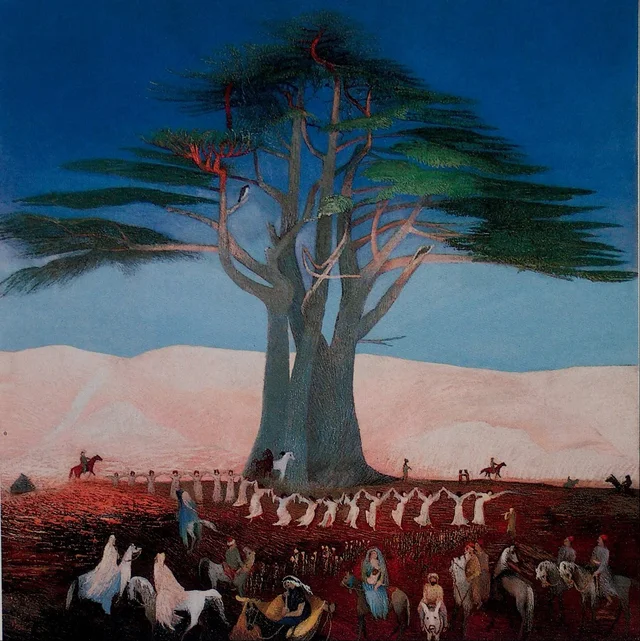
He travelled to Lebanon, Palestine, Sicily, Greece and Egypt, and brought back enormous, glowing canvases of cedar trees, ruins and skies, in intense, almost unnatural colour. The best known, the Solitary Cedar of 1907, shows a single wind-bent tree standing alone against a wide sky, an image many Hungarians read as a self-portrait. He had been born in 1853 in Kisszeben, a town then in the Kingdom of Hungary and now in Slovakia.
In his lifetime almost no one understood the work. Critics dismissed him, audiences were baffled, and he died in Budapest in 1919 believing himself a failure. After his death his huge canvases were nearly sold for their raw material, to be cut up as wagon covers, until a young architect outbid the tarpaulin buyers and saved them. Most of them now hang in a museum devoted to him in the city of Pécs.