Tobias Verhaecht
1561–1631 · Southern Netherlands · Mannerism
The story
In June 1594 Antwerp staged a ceremonial entry for Archduke Ernest of Austria, the new Habsburg governor, and the commission to design the decorations went to Tobias Verhaecht. The city had been taken by Spanish troops nine years before, the Dutch were blockading the river that carried its trade, and much of its merchant and artisan population had left for the north. The arches and stages went up anyway.
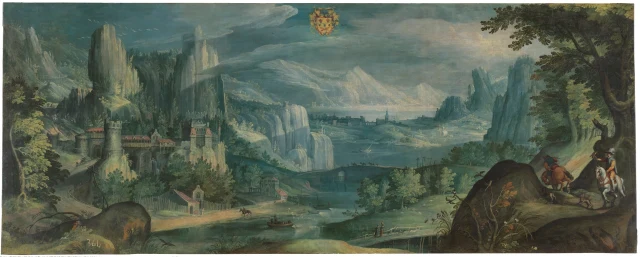
Verhaecht was 33 and not long back from Italy, where he had worked in Florence under the grand duke of Tuscany, Francesco I de' Medici, and then in Rome as a painter of landscape frescoes. What he made in Antwerp for the next 40 years was the world landscape, a view from an impossible height with mountains, rivers and towns receding through bands of brown, green and blue. It was the manner Joachim Patinir and Pieter Bruegel the Elder had established, and younger Flemish painters were already moving away from it. The small figures in his scenes were often another hand's work. Jan Brueghel the Elder or his studio put them into Verhaecht's paintings of the Tower of Babel.
Rubens came to him as a first master around 1592, aged about 15. Verhaecht had married a distant relative of the Rubens family the year before. The boy stayed roughly two years and moved on to Adam van Noort, who painted figures, which was what he wanted to do. Verhaecht went on teaching, his own son Willem van Haecht among the pupils, and kept up with the Gillyflower, the Antwerp chamber of rhetoric whose members wrote and staged plays. In 1620 he gave it a comedy of his own and two complete costumes for its torch-bearers.