Tom Thomson
1877–1917 · Canada · Canadian landscape painting, Early Canadian modernism
The story
For most of his life Tom Thomson made his living as a commercial engraver in Toronto, sketching in his spare time. He was in his mid-thirties before he first paddled into Algonquin Park, the wild lake country north of the city, and the north essentially made him a painter. In roughly five years he produced some 400 small oil sketches on wood panels, painted outdoors at a single sitting, along with about 50 larger canvases worked up later in his studio shack.
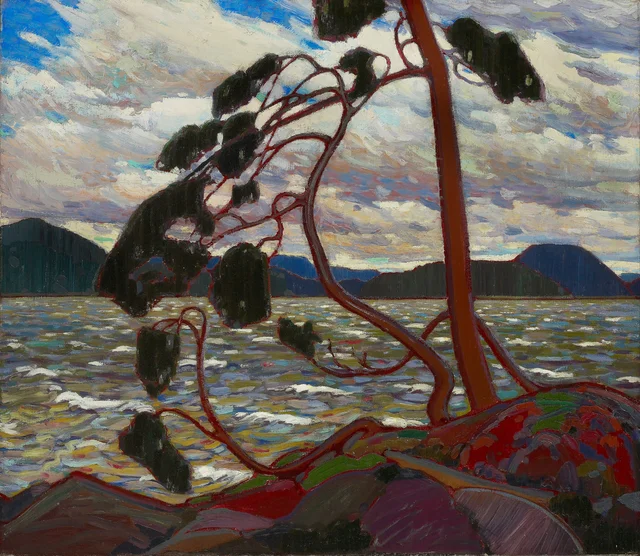
Those sketches are the reason his name survives. He would prop a panel on his knees and catch a stand of pines or a burnt-over hillside in wet, loaded strokes, the paint as blunt and bright as the weather. The two canvases that came out of this work and are still the best known, The Jack Pine and The West Wind, each show a single wind-bent tree against open water and sky, an image a whole country would later take as a picture of itself.
In July 1917 Thomson set out alone across Canoe Lake and did not come back. His overturned canoe was found that afternoon. His body surfaced eight days later. He was 39 and an expert canoeist, and the circumstances were murky enough that people have argued over accident, murder and suicide ever since, with nothing ever settling it. Three years after he drowned, the friends he had painted alongside formed the Group of Seven, the circle that would come to define Canadian landscape painting, and they always named Thomson as their forerunner.