Unknown French designer and South Netherlandish weavers
Kingdom of France, Southern Netherlands · Late Gothic
The story
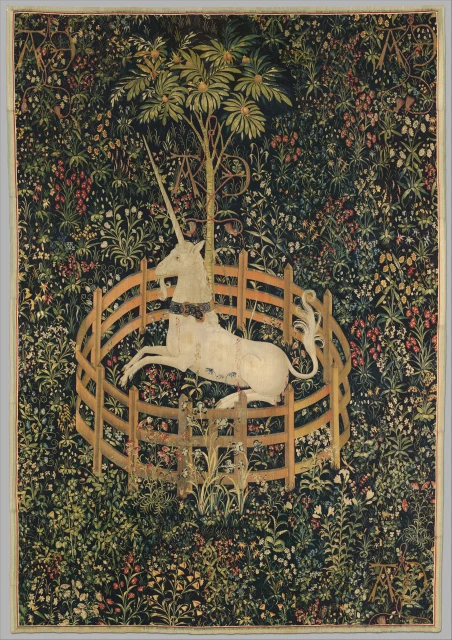
A white unicorn rests inside a low round fence, chained to a pomegranate tree in a meadow thick with flowers. The red drops on its flank come from the ripe fruit above it. This is the best-known of seven hangings, woven around 1495 to 1505 and now at The Met Cloisters in New York, and the name on this page stands for the people who made them.
The designs are credited to an artist working in Paris whose name is lost. The weaving was done in the Southern Netherlands, probably around Brussels, a leading tapestry centre of the day, in wool and silk with silver and gilt threads. Across the set, botanists have identified 85 of the more than 100 plants in the flowered grounds, and the letters AE recur in every panel without a secure explanation.
The hangings are first recorded in 1728, in an inventory of the La Rochefoucauld family, a French ducal house. During the Revolution they left the family's hands and, by later accounts, were used to cover potatoes. John D. Rockefeller Jr., the American philanthropist, bought them from the family in 1922 and later gave them to the Metropolitan Museum.