Vasily Perov
1833–1882 · Russian Empire · Realism
The story
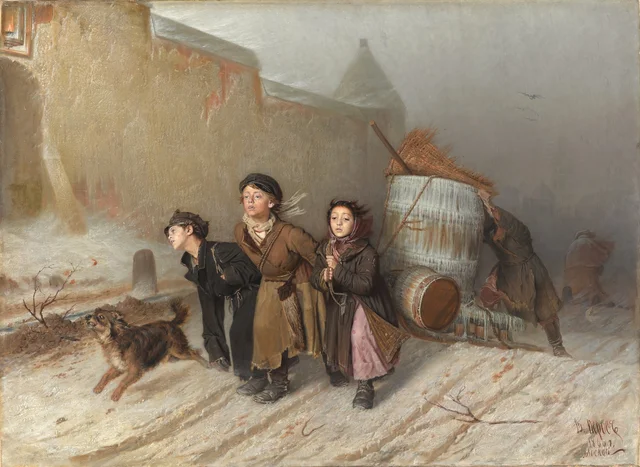
Russia had just abolished serfdom in 1861, and its cities filled with peasant families looking for work. Vasily Perov painted what that looked like from below. His best-known canvas, Troika, from 1866, shows three exhausted children in Moscow dragging an enormous barrel of water through a winter blizzard, harnessed to it like ponies. The title is a bitter joke, since a troika is normally three fine horses pulling a sleigh.
Perov trained at the Moscow art school and made his name with pictures that put priests, drunkards, and the rural poor at the center of serious painting, where the Academy expected saints and emperors. In 1870 he helped found the Peredvizhniki, the Wanderers, a group of realist painters who broke with the official Academy and took travelling exhibitions to provincial towns so ordinary Russians could see art.
He later turned to portraits, and it is often his 1872 face of the novelist Dostoevsky that people picture when they imagine the writer. A peasant woman once recognised her dead son in the ragged boy at the center of Troika and came to Perov begging to buy it. The barrel in that painting has frozen over, and the water sloshing out of it has turned to a sheet of ice down the boy's side.