Victor Borisov-Musatov
1870–1905 · Russian Empire · Symbolism
The story
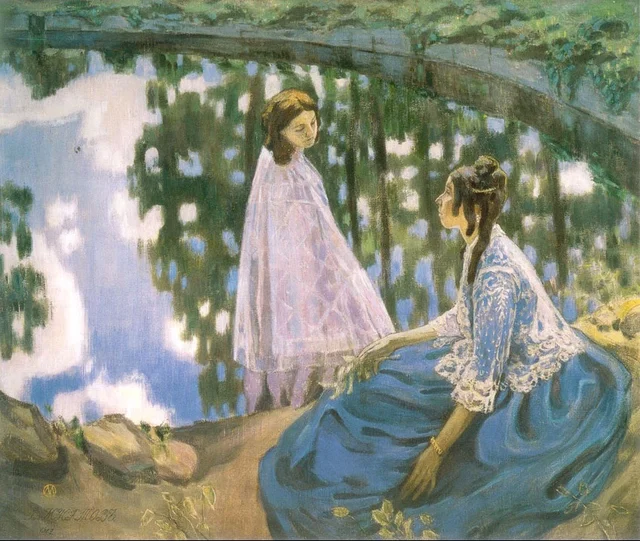
Victor Borisov-Musatov painted a Russia that was quietly disappearing: the old country estates of the gentry, their overgrown parks and still ponds, women in long dresses drifting through them like figures from an earlier century. He made these dreamlike scenes in the first years of the 1900s, in the last decade before revolution swept that world away.
A fall in childhood had left him with an injured spine and a hunched back. He grew up in Saratov on the Volga, the son of a railway clerk born a serf. He studied in Moscow and Saint Petersburg, then in Paris under Fernand Cormon, absorbing the soft color of the French painters before returning home to invent something of his own, part Symbolism, part decorative pattern.
His best-known canvas, The Pool of 1902, sets two women by a still sheet of water in the park of the Zubrilovka estate. The models were his sister and the artist Yelena Alexandrova, whom he soon married. Together with Mikhail Vrubel, a fellow Russian visionary, he is counted a founder of Russian Symbolism. He died of a heart attack in 1905, at 35, and was buried above the Oka River near Tarusa.