Vilhelms Purvītis
1872–1945 · Russian Empire, Latvia, Soviet Union, German Reich · Impressionism, Expressionism
The story
In 1902 a Latvian painter travelled to Spitsbergen, the Arctic archipelago north of Norway, for one reason: to study how snow actually holds light. Vilhelms Purvītis had already trained in Saint Petersburg under Arkhip Kuindzhi, a Russian master famous for glowing skies and moonlight, and he graduated in 1897 with the academy's Grand Gold Medal.
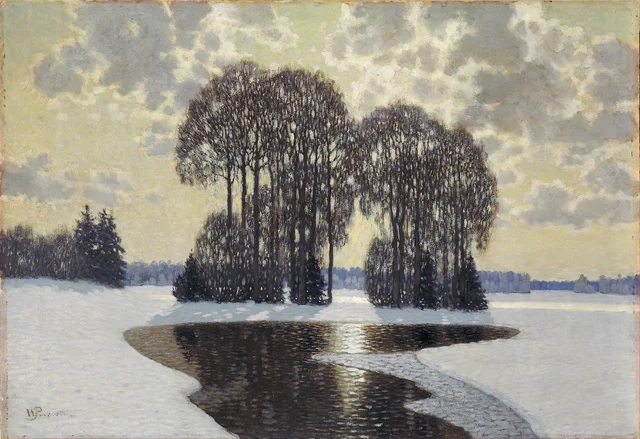
What he did with that training was turn the flat, wet, thawing Latvian countryside into a subject. His snow is rarely white; it carries blue shadow, the brown of meltwater, the low pink of a northern sun that barely clears the trees. Within a few years his work was shown in Berlin, Munich, Paris and Lyon, and collectors abroad began to know Latvia through his landscapes.
Then history handed him a country. When Latvia became independent after the First World War, Purvītis founded the Art Academy of Latvia in 1919 and served as its first rector until 1934, while also running the Riga art museum that is today the Latvian National Museum of Art. He built, almost single-handed, the ground on which a national school of landscape would grow.
He died in 1945 in Bad Nauheim in Germany, a refugee from the war, far from the birch woods and flooded meadows he had painted for fifty years.