Vito D'Ancona
1825–1884 · Kingdom of Italy · Macchiaioli
The story
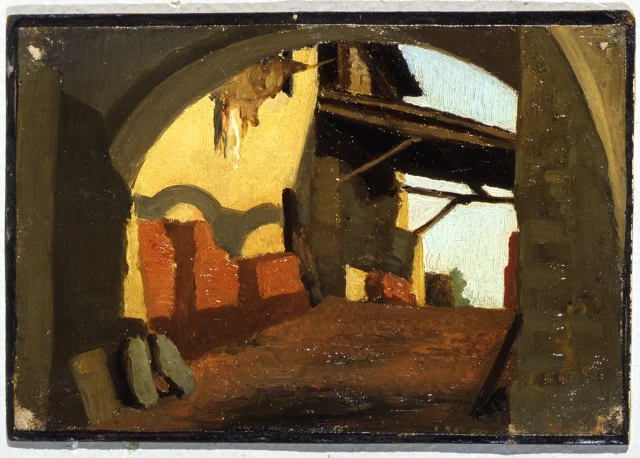
The D'Ancona in the modern gallery at the Pitti is about the size of a postcard, oil on cardboard, 14 by 21 centimetres, a portico with a band of sunlight across it. He painted it in 1861, and the museum treats it as the point where he stopped painting the way he had been taught.
The teaching was Giuseppe Bezzuoli's, at the Florence academy from 1844, where Telemaco Signorini was a fellow student. Vito D'Ancona's family were Sephardi Jews from Pesaro who moved to Pisa in 1827, when papal rules on Jewish communities tightened, and later to Florence. One of his brothers, Alessandro, became a well-known scholar of Italian literature. Vito volunteered in the 1848 war against Austria and fought at Curtatone, south of Mantua.
By the mid-1850s he was among the painters at the Caffè Michelangiolo who worked in flat patches of light and shade, and he was the one who brought Signorini into that circle. In 1867 he moved to Paris for seven years, close to the Italians working there, Giovanni Boldini and Giuseppe De Nittis, and took in the Japanese prints then circulating, which show in his Woman at the Races of about 1873. Syphilis wrecked his health in the 1870s. He returned to Florence in 1875, stopped painting in 1878, and died there in January 1884.