Viviano Codazzi
1604–1670 · Republic of Venice · Baroque, Architectural painting
The story
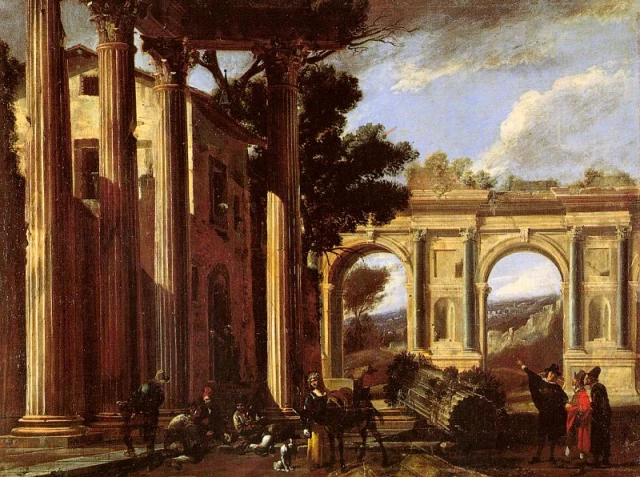
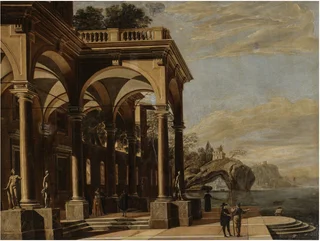
Look at almost any grand painted ruin from seventeenth-century Italy and you may be looking at the work of two hands. Viviano Codazzi painted the architecture, the crumbling colonnades and sunlit arches, while a partner filled in the small figures who wander through them. That division of labour was his trade, and he raised it into an art.
Born around 1604 near Bergamo, in the hills of Valsassina, he grew up in Rome after his family moved there. By 1633 he was in Naples, drawn partly by a fellow Bergamasque, the sculptor and architect Cosimo Fanzago. There he built his reputation on painted views of buildings and ruins, working beside the figure painter Domenico Gargiulo, known as Micco Spadaro. Their most ambitious job was a set of large canvases of ancient Rome for the Buen Retiro palace in Madrid, one of them showing gladiators fighting in the Colosseum.
When the Masaniello revolt broke out in Naples in 1647, Codazzi left for Rome and stayed there the rest of his life. He joined the circle of painters who supplied figures for his scenes, among them the Flemish Jan Miel and the Roman Michelangelo Cerquozzi, and became the most sought-after painter of architectural views of his day.
He married Candida Miranda in Naples in 1636, and two of their sons, Niccolo and Antonio, followed him into painting. Codazzi died in Rome on 5 November 1670.