Vladimir Borovikovsky
1757–1825 · Russian Empire · Sentimentalism, Neoclassicism
The story
Sometime around 1794 the most powerful woman in Europe agreed to be painted taking a morning walk. Catherine the Great, empress of Russia, appears in a simple dress and cap on a path in the park at Tsarskoye Selo, her little dog at her feet, far from any throne. The painter was Vladimir Borovikovsky, and this quiet, human image of a ruler was something new in Russia. It was the first breath of sentimentalism, the taste for tender private feeling, in Russian painting.
Borovikovsky had come a long way to that path. He was born in Ukraine into a family of icon painters and learned the craft of sacred images before he ever painted a face from life. A commission to decorate a palace for Catherine's tour of the south caught the empress's eye, and she brought him to Saint Petersburg, where writers and poets in his circle shaped his gentle, inward style.
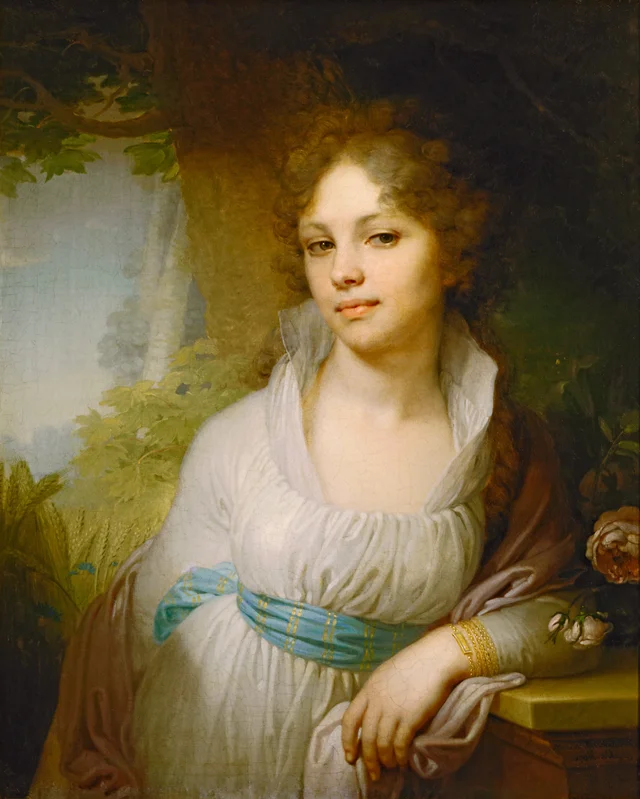
His finest portraits are of women, caught in a mood of soft melancholy. The best known shows the young Maria Lopukhina leaning against a rail, roses fading beside her, a picture later read as a quiet emblem of beauty that does not last. She died of consumption a few years after she sat for it.