Vlaho Bukovac
1855–1922 · Austrian Empire · Post-impressionism
The story
In 1878 the jury of the Paris Salon accepted a painting called A Montenegrin Woman, and with it, for the first time, the name of a Croatian painter entered the records of that exhibition. The painter was Vlaho Bukovac, born Biagio Faggioni in the small Dalmatian port of Cavtat near Dubrovnik, son of a Genoese father and a Croatian mother. He had reached Paris the year before and talked his way into the École des Beaux-Arts, into the studio of Alexandre Cabanel, the reigning academic master of the Salon.
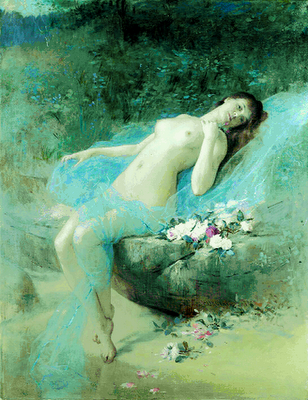
For roughly 15 years he built a French career of polished nudes and society portraits, best known for a nude of 1887 called Une fleur, A Flower. Then he went home. From 1893 he settled in Zagreb, and his arrival set off the liveliest chapter Croatian painting had known: he lightened his palette, loosened his brush toward something close to Impressionism, and drew younger painters around him into what became known as the colourful school. In 1895 he painted the great curtain for the new Croatian National Theatre, a crowded allegory of a national cultural revival.
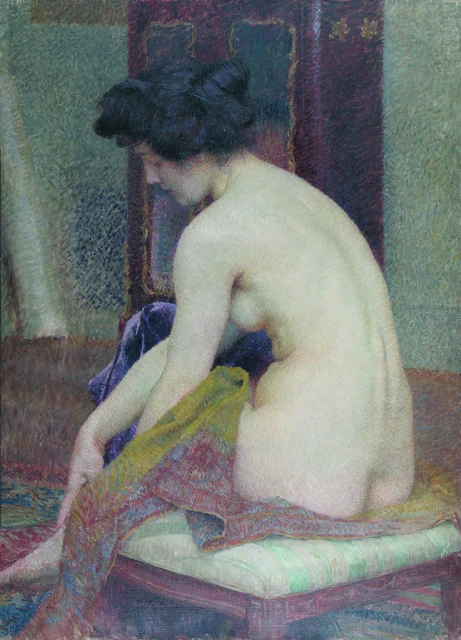
He kept moving. In 1903 he took a professorship at the Academy of Fine Arts in Prague, where he tried out pointillism, building pictures from small separate touches of colour, and there he stayed until his death in 1922.