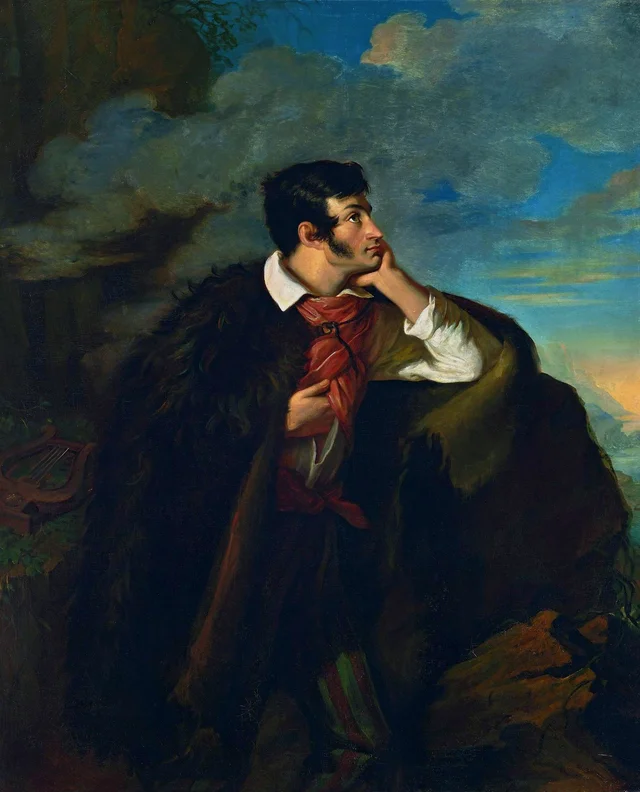
Walenty Wańkowicz
1799–1842 · Russian Empire · Romanticism
The story
In 1828 Walenty Wańkowicz showed a portrait of his friend Adam Mickiewicz, the poet, at the Academy exhibition in Saint Petersburg. He placed him on a cliff above the Black Sea, at the Ayu-Dag of the poet's Crimean Sonnets. The picture became the best-known image of the young Mickiewicz and is now in the National Museum in Warsaw.
Wańkowicz was born in 1799 at Kałużyce near Minsk. He studied painting at Vilnius University under Jan Rustem, the city's leading portraitist, then spent two years at the Imperial Academy of Arts in Saint Petersburg. He had first painted Mickiewicz in 1821, and in the Russian capital the two moved in the same Polish circle.
His other ambitious work was Napoleon at the Campfire of 1834, an allegorical full-length portrait of the emperor. In autumn 1841, already ill with tuberculosis, he came to Paris and stayed with Mickiewicz. There he fell under the spell of Andrzej Towiański, a mystic preacher among the Polish émigrés, and painted him several times. Mickiewicz witnessed his last will. Wańkowicz died in Paris in 1842 and was buried in Montmartre Cemetery.