Wijnand Nuijen
1813–1839 · Kingdom of the Netherlands · Romanticism, Landscape painting
The story
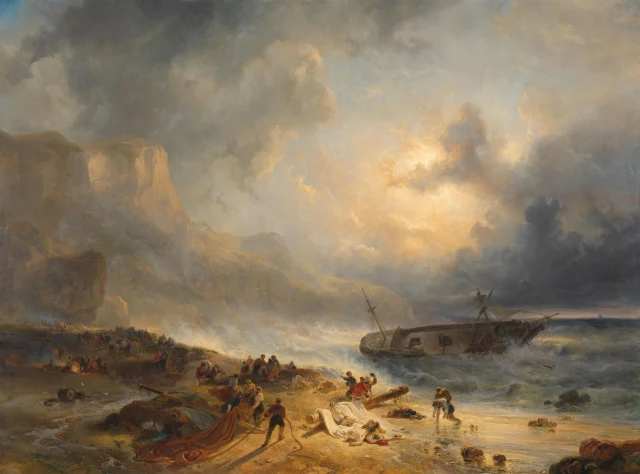
Around 1837 Wijnand Nuijen, then about 24, painted a three-master wrecked on a rock in a storm, its crew searching the beach for survivors beneath towering cliffs. The canvas is about two metres wide, and the people fill only a small part of it. In 1843 King William II bought the picture. He already owned five other paintings by Nuijen, who by then had been dead for four years.
Nuijen was a baker's son from The Hague. At 12 he was apprenticed to Andreas Schelfhout, the city's leading landscape painter, and at 16 he won a medal from the Amsterdam society Felix Meritis for a watercolour of a forest. Journeys to Germany, Normandy, the northern French coast and Paris drew him to the Romantic painting being made in France, above all the English painter Richard Parkes Bonington and the Frenchman Eugène Isabey. Their quick, loose handling passed into Nuijen's own harbours, ruins and seascapes. In 1836 he became a member of the Royal Academy in Amsterdam.
His last years were marked by illness. He is said to have worked through severe pain, worn out after a quarter of an hour at the easel. About a year before his death he married Schelfhout's daughter. He died in The Hague on 2 June 1839, aged 26, and two young painters he had briefly taught, Charles Rochussen and Charles Leickert, were among the bearers at his funeral.