Wilhelm von Kobell
1766–1853 · Kingdom of Bavaria · Romanticism, Neoclassicism
The story
In the Napoleonic years, with Bavaria fighting at France's side, Wilhelm von Kobell was commissioned to record the campaigns in a series of 12 large battle paintings, a project that occupied him until about 1817. The first, The Siege of Kosel in Silesia, now in Munich's Neue Pinakothek, shows hardly any battle at all. A group of commanders stands on a rise in the early morning sun, looking out over the distant town, while the fighting goes on small and shadowed in the valley below.
Kobell was born in Mannheim in 1766 into a family of artists. His father Ferdinand and his uncle Franz were landscape painters and draughtsmen at the court of the Elector Karl Theodor, who later ruled Bavaria from Munich, and in 1793 Wilhelm became court painter there. He spent the winter of 1809 to 1810 in Paris with his brother Egid, and in 1814 he was made professor of landscape painting at the Munich academy.
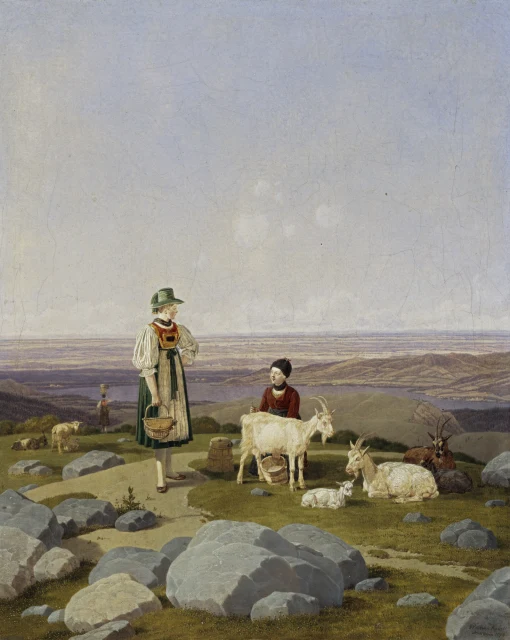
The pictures most tied to his name are small. Riders, hunters and officers meet on an open path under a sky that fills more than half the canvas, the light low and the shadows long. Collectors sought out these encounter pictures, and they fed into the quiet, close-observed painting of the Biedermeier years after Napoleon. Kobell was ennobled in 1817 and died in Munich in 1853, at the age of 87.