Willem de Famars Testas
1834–1896 · Kingdom of the Netherlands · Orientalism
The story
In May 1858 Willem de Famars Testas, a 24-year-old painter from Utrecht, left for Egypt as the hired draughtsman of Émile Prisse d'Avennes, a French scholar of Egyptian and Islamic art on a mission paid for by the French state. The journey was planned for five months and lasted two years. With the photographer Édouard Jarrot he helped produce hundreds of drawings and photographs of temples, tombs and the old buildings of Cairo, and he sometimes worked over Jarrot's prints, adding figures or sharpening a minaret or a dome. Prisse d'Avennes used the material for his large illustrated books on Egyptian and Arab art and left both men's names off it. Testas kept a diary and wrote home to his parents throughout.
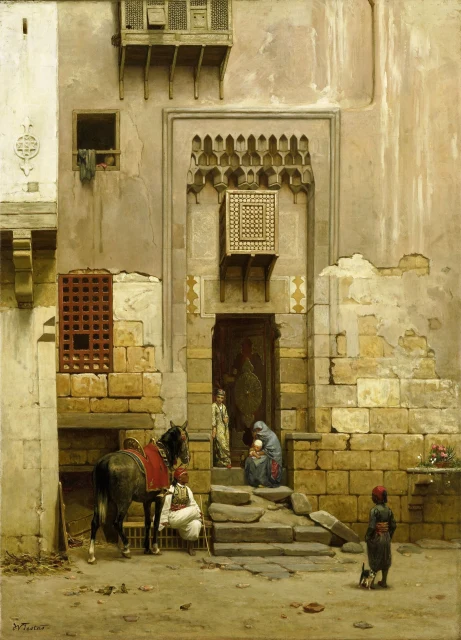
Back in the Netherlands he became one of very few Dutch painters of the Orient, with precise scenes of Egyptian streets, courtyards and desert camps that sold better in England and France than at home. In 1868 he travelled through Egypt, Palestine and Syria at the invitation of the French painter Jean-Léon Gérôme. He lived in Brussels from 1872 to 1885 and died in Arnhem in 1896. His daughter Marie also became a painter.