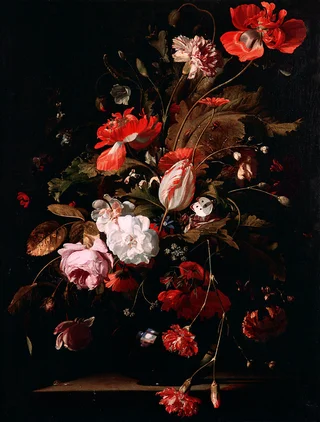
Willem van Aelst
1627–1679 · Dutch Republic · Dutch Golden Age, Still life painting
The story
Most Dutch still-life painters stayed close to home. Willem van Aelst did not. Born in Delft in 1627 into a family of city magistrates, he learned the trade from his uncle Evert, a still-life painter, then spent years in France before reaching Florence, where he became court painter to Ferdinando de' Medici, grand duke of Tuscany. The duke, the story goes, rewarded him with a gold medal and a gold chain, and van Aelst began signing his work in an Italian hand, "Guillielmo".
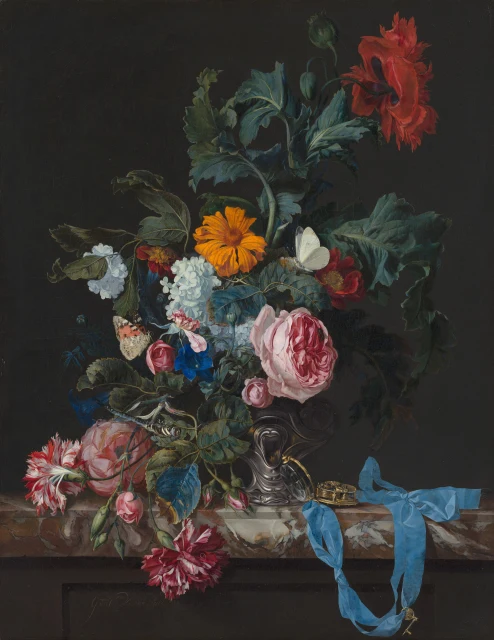
Back in Amsterdam from the mid-1650s, he made his name on two kinds of picture. One was the hunting still life: dead game birds, a gun, a velvet pouch, laid out with the sheen of satin and silver. The other was the flower bouquet, and here he did something new, letting the blooms lean and spill to one side instead of sitting in a tidy symmetrical mound. That loosened, asymmetrical arrangement became a lesson for the generation after him.
His most famous pupil was Rachel Ruysch, who as a girl trained in his studio and went on to a long career as the most celebrated flower painter of the Dutch Golden Age. Van Aelst often tucked a stopped pocket-watch into his bouquets, a reminder that the flowers, at the height of their colour, were already dying.