William Allan
1782–1850 · Scotland · Historical painting, Romanticism
The story
In 1805 a young Edinburgh painter set out by sea for St Petersburg and did not get there that way. William Allan's ship was wrecked at Memel, a Baltic port then in Prussia, and he paid for the rest of the journey by painting portraits. On the road to the Russian capital he passed columns of the Russian army heading west to the campaign that ended at Austerlitz.
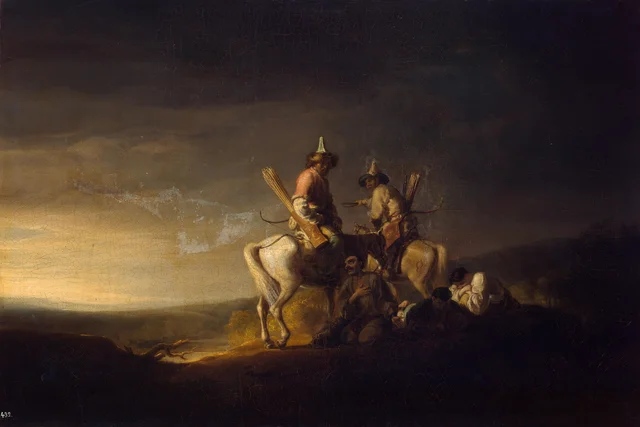
He stayed in the Russian Empire for about nine years. He learned the language, spent long stretches in Ukraine, and travelled among Cossacks, Circassians and Tatars, collecting their weapons and armour to use later as studio props. The Bashkirs, dated 1814 and now in the Hermitage in St Petersburg, comes out of that world. The Bashkirs are a Turkic people of the southern Urals whose horsemen served in the Russian army. Allan was still in Russia during Napoleon's invasion of 1812 and went home to Edinburgh in 1814.
At home the Russian subjects were hard to sell. His Circassian Captives drew attention at the Royal Academy in London in 1815 and found no buyer, until his friend the novelist Walter Scott helped raise 1,000 guineas by subscription and the picture was given away by lottery. Allan then turned to Scottish history, with scenes such as John Knox admonishing Mary, Queen of Scots. He became president of the Royal Scottish Academy in 1838 and, after the death of his old classmate the painter David Wilkie, Queen's Limner for Scotland, the monarch's official painter there. He died in 1850 with a large Battle of Bannockburn still unfinished in his studio.