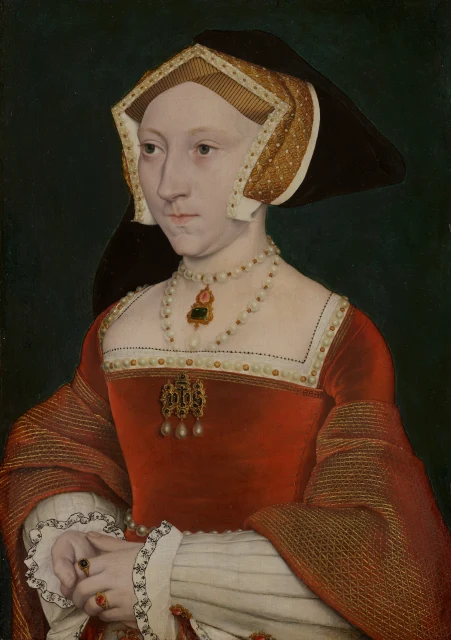
Workshop of Hans Holbein the Younger
Holy Roman Empire · German Renaissance
The story
When Henry VIII's court wanted a likeness of the king or one of his queens, a single sitting with Hans Holbein the Younger could supply many pictures. Holbein, the German-born painter who worked for the Tudor court from the mid-1530s until his death in London in 1543, made careful chalk drawings from life, and those drawings could be traced and transferred to panel again and again. Much of the painting after them was done by assistants in his workshop, whose names are almost entirely unrecorded.
That is what a museum means by "studio of Holbein": a picture built on his design and made in his workshop, by a hand that cannot be named. Jane Seymour, Henry's third wife, is a case in point. She died in 1537, days after giving birth to the future Edward VI, and Holbein's drawing of her survives in the Royal Collection at Windsor. It shows signs of having been reused as a pattern for several paintings.
The Mauritshuis in The Hague holds one of them, a panel about 26 centimetres high, painted around 1540 and listed as studio work.