Workshop of Leonardo da Vinci
High Renaissance
The story
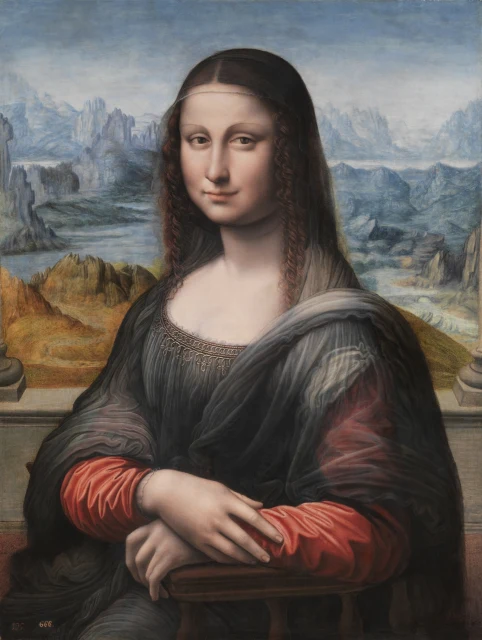
In 2012 the Museo del Prado sent a painting it had long treated as one more old copy to an exhibition at the Louvre in Paris. Conservators looked under the surface first. Infrared imaging showed an underdrawing that followed the Louvre's own Mona Lisa through every change of mind, the bases of the columns at her sides, the hands shifting on the armrest. Whoever drew it was in the room while both panels were taking shape. The same campaign lifted a layer of black overpaint added roughly two centuries later, and the Tuscan landscape came back behind her shoulders.
That panel shows what this label means. Workshop of Leonardo da Vinci is an attribution line, the wording a museum uses when a picture came out of the master's studio and no single hand can be named. Leonardo kept a working studio in Florence and in Milan, with assistants housed and fed, and producing versions of his compositions was ordinary business there. The names usually raised for the Prado picture are Salaì and Francesco Melzi, his two closest pupils, along with the Milanese painters Giovanni Antonio Boltraffio and Marco d'Oggiono. The museum names none of them.
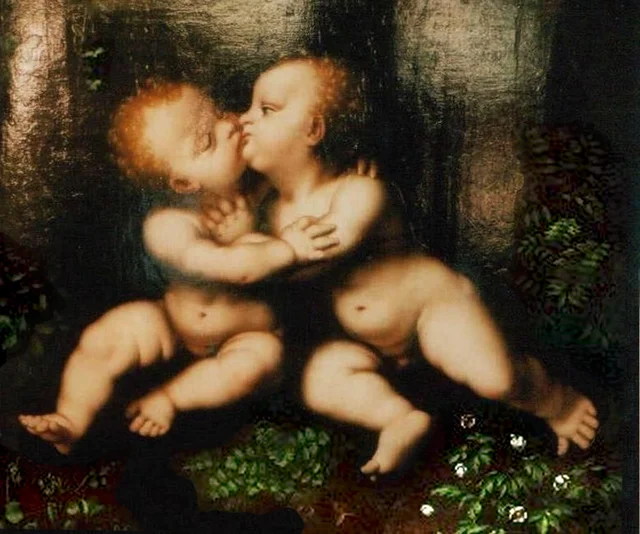
The wording carries a claim about place and time. Workshop of says the thing was made inside the master's shop while he was alive, sometimes beside the original. Follower of, attributed to, copy after and imitator of all sit further off, usually later and somewhere else. Another painting under this name, The Holy Infants Embracing, shows the child Christ holding the young John the Baptist, a composition by Leonardo that is now lost and that his pupils and imitators repeated around 30 times. The Prado hangs its version of the Mona Lisa in Room 052B, a walnut panel 76 centimetres tall, dated by the museum to somewhere between 1507 and 1516.