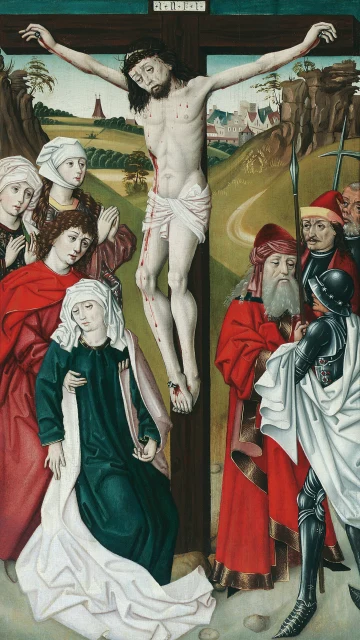
Workshop of the Master of the Schotten Altarpiece
Holy Roman Empire · Late Gothic
The story
Between 1469 and 1475 the Benedictine abbey in the centre of Vienna known as the Schottenstift, the Scots' Abbey, named after the Irish monks who first lived there, received a new high altar. It grew to 24 painted panels telling the life of the Virgin and the Passion of Christ, and 21 of them survive, divided between the abbey's own museum and the Belvedere. The painter who led the work is anonymous. Art historians call him the Master of the Schotten Altarpiece, and his panels show a close study of Netherlandish and Nuremberg painting. Behind his Flight into Egypt lies a view of Vienna around 1470, often cited as the earliest realistic picture of the city.
Several hands worked on the altar, and this entry stands for them. The Belvedere's Crucifixion, painted on oak around 1475 and usually counted among the altar's surviving scenes, is catalogued by the museum as the work of the master's circle, a painter from the same Viennese workshop whose name, like the master's, is lost. The Belvedere also holds the Adoration of the Magi and the Lamentation from the same altar, both credited to the master himself.