Xu Beihong
1895–1953 · Chinese · Chinese modern art, Realism
The story
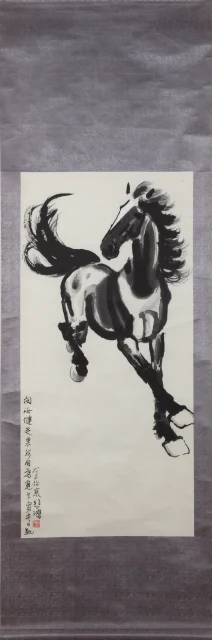
During the war against Japan in the late 1930s, one image kept spreading across China in reproductions and exhibitions: a horse at full gallop, mane flying, painted in nothing but black ink. The man behind it, Xu Beihong, meant the animal to stand for a country refusing to give in, and for many viewers it did exactly that.
He had come to horses by a long road. Born in 1895 in Yixing, near Shanghai, he learned brush and ink from his father, then in 1919 won a place at the École des Beaux-Arts in Paris, the French national art school. Eight years in Europe gave him a firm command of academic drawing and oil painting, and he went home convinced that Chinese art needed that kind of disciplined realism to renew itself, a view he argued for the rest of his life.
His horses are where the two trainings meet. He drew them with Western anatomy and foreshortening, then laid that structure down in the loose, wet brushstrokes of traditional ink. He built the same fusion into huge history paintings like The Foolish Old Man Who Removed the Mountains, a fable about perseverance he painted in 1940, modelling the nude body in the Western way over Chinese ink.
In 1949 the new People's Republic made him the first president of the Central Academy of Fine Arts in Beijing and head of the national artists' association. He held both posts only briefly. He died in 1953, at 58, of a stroke, in the city where he had just begun to run its art schools.