Zoltán Palugyay
1898–1935 · Czechoslovakia · Modernism
The story
In September 1935 the painter Zoltán Palugyay set out alone into the Low Tatras, the mountain range of central Slovakia, and never came back. He was 36. Only in July 1936 did a shepherd find his remains on the slope below Štefánik's hut, near the peak of Ďumbier, and how he died has never been settled.
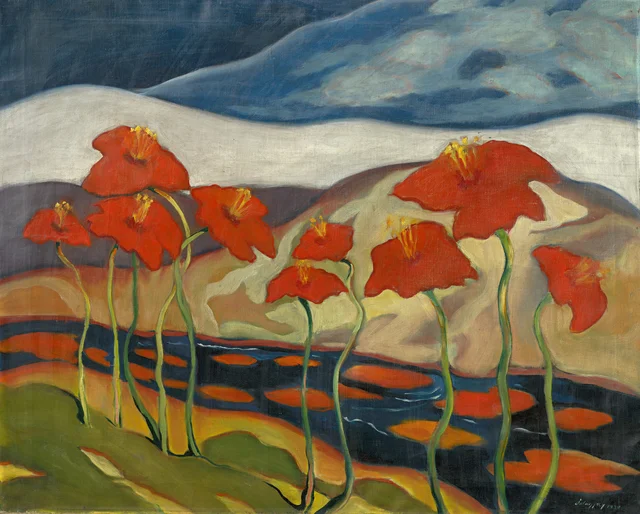
Palugyay, Zolo to his friends, came from an impoverished gentry family in Bodice, a village now part of the town of Liptovský Mikuláš. His training took him across Central Europe, from the Budapest academy to Kraków and Berlin, and finally to Munich. There, from 1924 to 1926, he studied at the private school of Hans Hofmann, the German-born teacher who later taught a generation of abstract painters in New York. Palugyay tried out impressionism, symbolism and fauvism before settling into a sturdy expressionism of blocky, almost cubist forms. The older landscape painter László Mednyánszky was another strong influence.
Back home in the Liptov region, he kept returning to the same motifs, village cottages, mountain fields and still lifes, and he treated the cottages as an image of his nation's fate. From 1930 he exhibited across central Slovakia with two painters of his generation, Miloš Alexander Bazovský and Janko Alexy, and he is now counted among the founding figures of Slovak modern painting. One of his landscapes with flowers, dated 1930, belongs to the Slovak National Gallery in Bratislava.