A Pavane
Details
The story
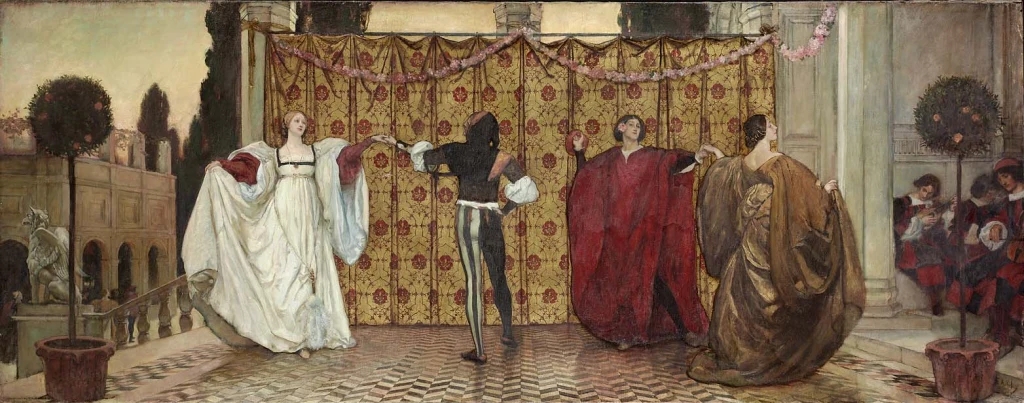
In the mid-1890s the architect Stanford White was remodelling the New York apartment of Whitelaw Reid, publisher of the New York Tribune and later ambassador in London, in the Villard Houses on Madison Avenue. The dining room was some 21 metres long, with a fireplace of dark pink marble by the sculptor Augustus Saint-Gaudens and his brother Louis. White asked his friend Abbey for a canvas to hang above it. The Reids wanted something to brighten a dark room, and White first suggested a banquet. Abbey sent two sketches and proposed dancers instead. In December 1895 Reid wrote to White that he liked a dancing scene quite as well as a banquet, and that he suspected his wife would agree once it was finished.
Abbey painted it in his studio at Fairford, in Gloucestershire. A pavane is a slow, stately court dance of the Renaissance, and he lined the couples up like a frieze between clipped topiary trees, in front of a hanging of patterned cloth touched with gold, on a herringbone floor drawn with great care. Before delivery it went to the Society of American Artists exhibition in New York in 1897, and the New York Times critic wrote that one almost hears the tinkling of the mandolins. The Reids paid 5,000 dollars for it. The painting left the house after the apartment was closed in the 1930s, but the dining room and its fireplace survive as part of the New York Palace Hotel.