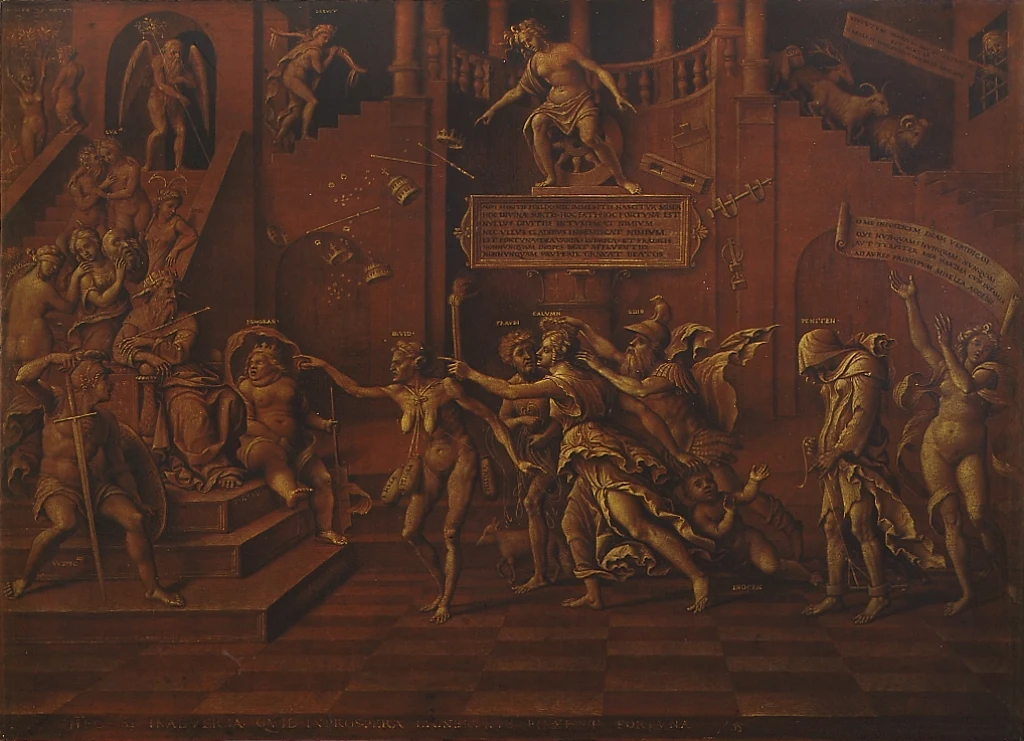
Allegory of Fortune
Details
The story
Nobody in the 16th century had seen the painting this one is built from. Apelles, the most celebrated painter of ancient Greece, was said to have made a picture of Calumny after being slandered at court, and it was long lost. What survived was a description of it by Lucian, a Greek writer of the second century. Renaissance artists treated that text as a set of instructions and reconstructed the thing from words.
Leonbruno follows Lucian closely. The figures climb the steps of a great building. The tyrant with donkey's ears listens to Suspicion and Ignorance, and Calumny is led forward by Envy and Fraud, with Repentance and Truth behind. Then he adds his own presiding figure. Fortune sits above and hands out money, sceptres and crowns to the bad characters, and throws chains and instruments of torture to the good ones.
He painted it around 1523. He was the Gonzaga court painter at Mantua, salaried since 1511 and protected by Isabella d'Este. Giulio Romano arrived from Rome the following year, and by January 1525 Leonbruno was writing to complain that the work had stopped coming to him. The panel is done in grey monochrome heightened with gold, in the hard Mantegna-like manner that Mantua had used a generation earlier.