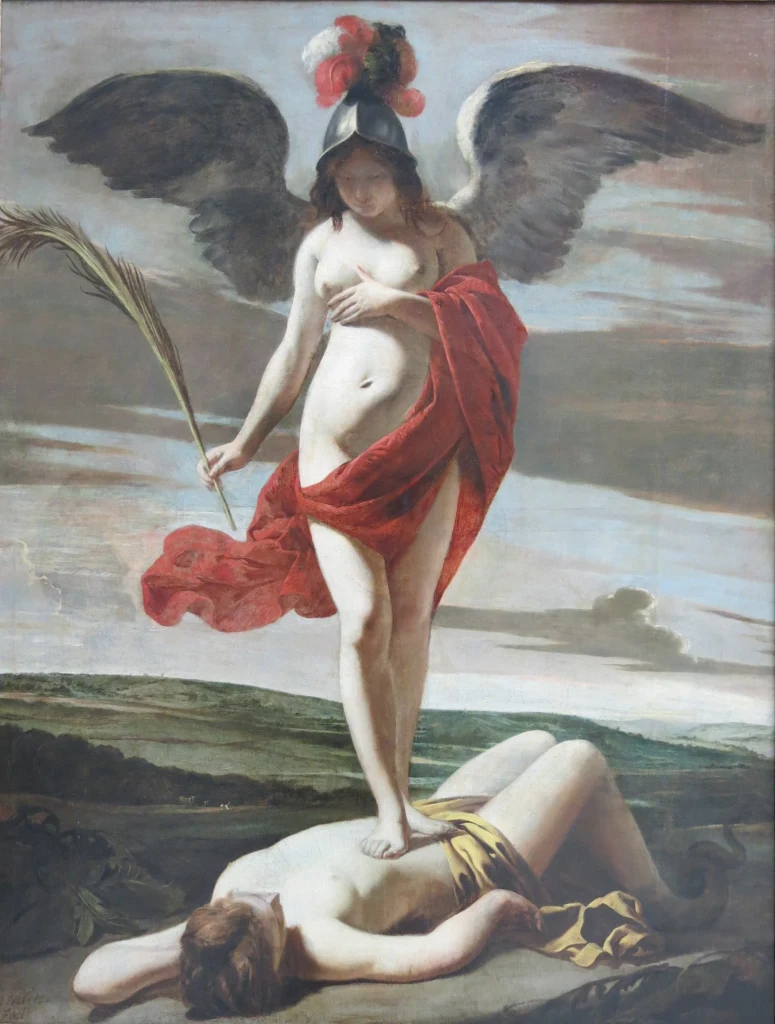
Allegory of Victory
Details
The story
This canvas turned up in the 1960s in a family château. Jacqueline Pruvost-Auzas, director of the museums of Orléans, was preparing an exhibition for the 200th birthday of the Neoclassical painter Anne-Louis Girodet, due in 1967, and went to see his descendants at the château of Cheneviery, in the Sologne south of Orléans. The Victory was there. Four years later, in 1971, the Louvre bought it with help from the Society of Friends of the Louvre.
It is so far the only allegory known by the Le Nain brothers. The winged figure in a plumed helmet stands on a fallen man whose body ends in a serpent's tail. The Louvre's catalogue reads him as Deceit or Treason and suggests a link with the siege of La Rochelle in 1627 and 1628, when the Protestant town shut its gates on the king. X-rays show that the Victory was painted over an earlier Holy Family with Saint John and Saint Elizabeth.