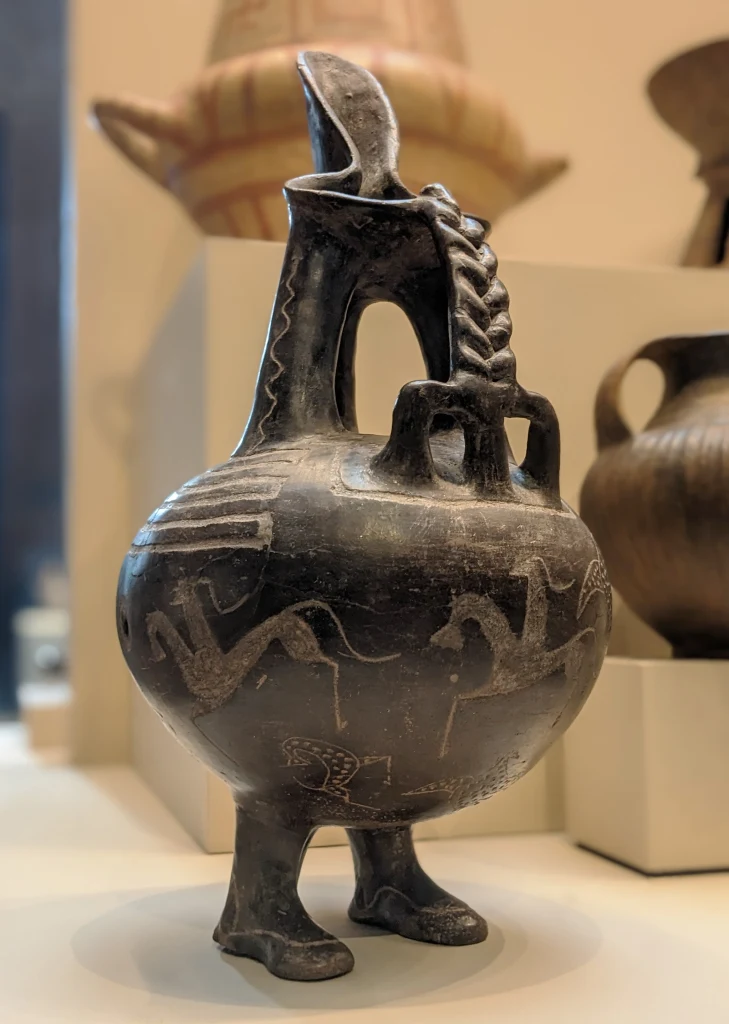
Anthropomorphic Oinochoe with Incised Decoration
Details
The story
Between about 710 and 670 BC, southern Etruria and the Faliscan country, home of a people on the Tiber north of Rome whose language was close to Latin, were changing fast. Phoenician and Greek traders brought eastern luxuries and new habits, drinking wine at banquets among them, and archaeologists call these generations the Orientalizing period. Oinochoe, the Greek word for a wine jug, is the name they give this shape.
The potter made it from impasto, the dark, coarse clay of central Italy, and gave it a body of its own. The jug stands on a pair of modelled human legs, complete with feet. Its neck is built of three tubes meeting in one spout, one tube restored, with a braided handle behind. Figures were cut into the surface and the grooves filled with red paint so they would show against the black. Around the belly gallop horses whose riders may be monsters, one horse appears to be swallowing a human figure, and spotted cats and birds fill the gaps.
The Louvre bought the jug in 1958 from the collection of the antiquities dealer Jacob Hirsch, and it now counts it among the 100 masterpieces of its Etruscan collection.