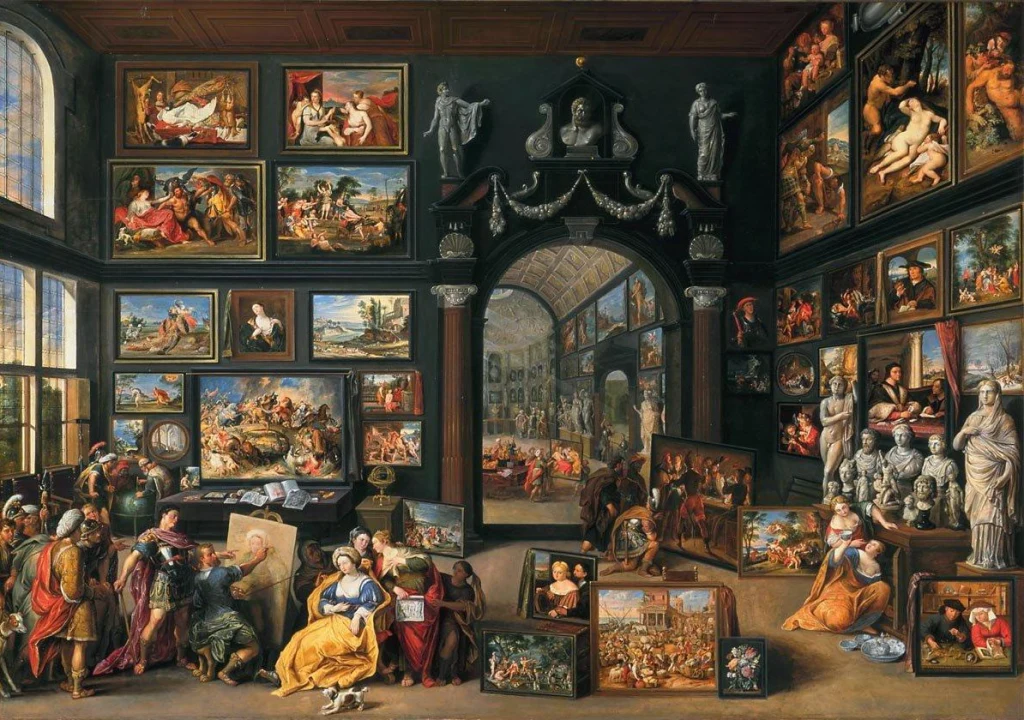
Apelles Painting Campaspe
Details
The story
In 1619 the members of Antwerp's painters' guild were praised as faithful students of Apelles, court painter to Alexander the Great, and Rubens was called the Apelles of his age. Around 1630 Willem van Haecht put that ancient artist in the foreground here, painting Campaspe, Alexander's mistress. In the Roman writer Pliny's account the king likes the portrait so much that he gives her to the painter. Tradition showed her nude. Van Haecht paints her clothed, as the loveliest of three beauties, one of whom holds a print of the Judgement of Paris. Behind them more than 50 pictures cover the walls, over half by Flemish masters. He was curator to the collector Cornelis van der Geest, yet this room never existed. He mixed works he saw daily with Italian paintings that were never in the city, and took the curved niche at the back from Rubens's own house.