Astronomical Observations
Details
The story
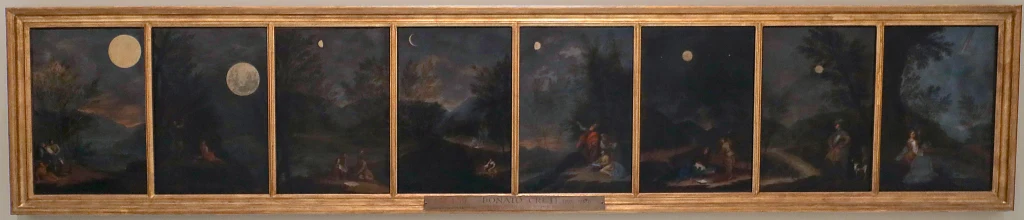
In 1711 Bologna had one of the oldest universities in Europe and no public observatory. Luigi Ferdinando Marsili, a Bolognese count who had served as a general in the imperial army and was a serious naturalist, set out to change that with an unusual piece of persuasion. He had Donato Creti paint eight small canvases, each showing one heavenly body through the instruments of the day, the Sun, the Moon, Mercury, Venus, Mars, Jupiter, Saturn and a comet, and gave them to Pope Clement XI. The astronomer Eustachio Manfredi wrote out the hour of night and the instrument for each scene. Creti painted the tiny observers in 18th-century dress, almost lost in the dark landscapes, while the planets themselves were the work of a miniaturist, Raimondo Manzini, who first looked at them through a telescope. Uranus is missing, since nobody found it until 1781. With the pope's support, Bologna soon had its first public observatory. On the Jupiter canvas the planet carries a red spot, often cited as the earliest known picture of the Great Red Spot painted red.