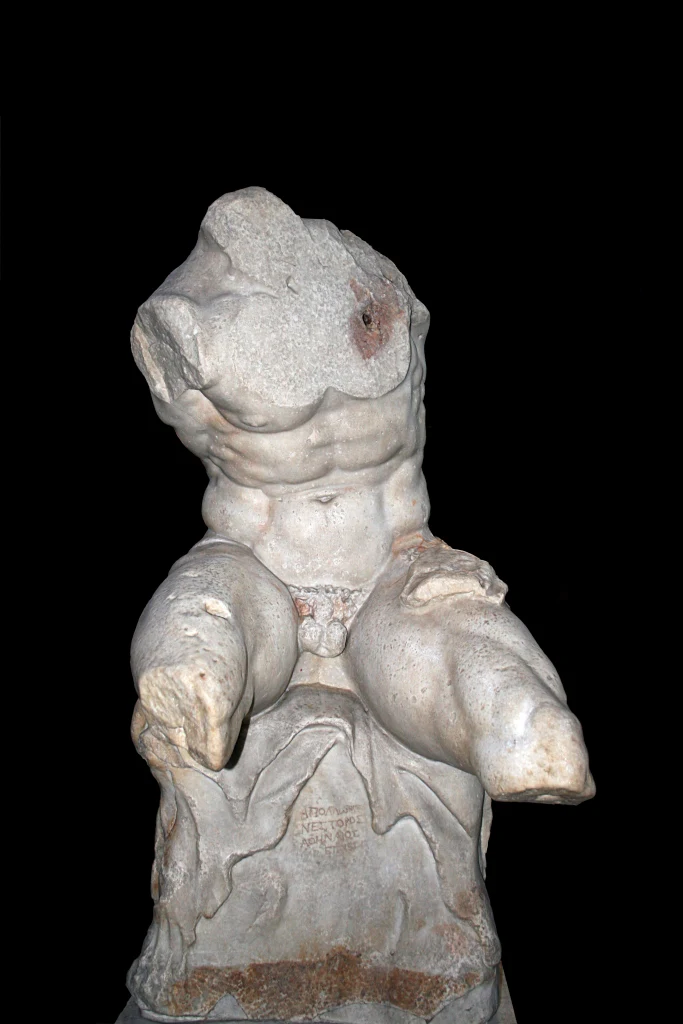
Belvedere Torso
Details
The story
For most of its history this headless, armless marble was called Hercules. The figure sits on an animal skin, and the skin was taken for the hide of the Nemean lion, the beast Hercules killed with his bare hands. A closer look suggested a panther instead, and the Vatican now favours another hero of the Trojan War, Ajax, son of Telamon. When the armour of the dead Achilles, which Ajax claimed for himself, was awarded to Odysseus, he was consumed with rage and killed himself with his own sword. In the reconstruction the museum follows, the lost head leaned sadly toward the right hand, which gripped that sword.
An Athenian sculptor named Apollonios signed it on the front of the base in the 1st century BC, probably working from a bronze of the first half of the 2nd century BC. The Torso entered the Vatican collections between 1530 and 1536, and artists have drawn it ever since. A favourite story says that Pope Julius II asked Michelangelo to complete it and that he refused, calling it too beautiful to touch. No document backs the story, and Julius died in 1513, years before the fragment reached the papal collection. No one ever gave it a head or limbs.