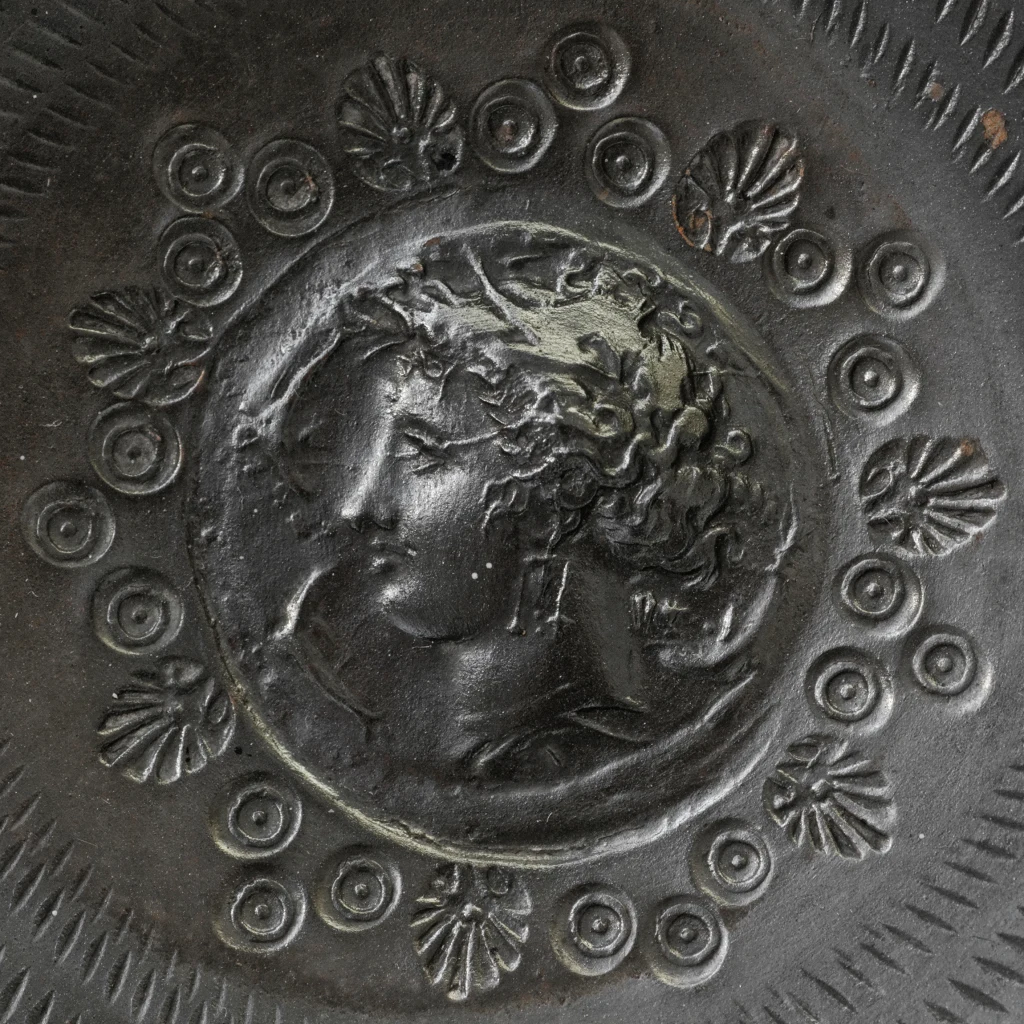
Black-Glaze Cup with a Relief Medallion of Arethusa
Details
The story
Syracuse, the great Greek city of Sicily, put the head of the nymph Arethusa on its silver coins, ringed by four dolphins. In the myth she fled from a river god under the sea and came up as a freshwater spring on Ortygia, the island at the heart of the city, so the dolphins stand for the sea around her. In the bottom of this black cup the same head turns to the left in low relief, the dolphins faint in the field. Potters in Campania made medallions like this by pressing clay into moulds taken from the coins themselves, and so a design cut by a Sicilian die engraver ended up inside a drinking cup more than 400 kilometres away. This one was made, probably in Campania, in the 3rd century BC, when that part of Italy had largely passed under the control of Rome, and its glossy black surface imitated far costlier vessels of silver. Around the medallion run seven stamped palmettes, alternating with groups of little circles. The Louvre bought the cup in 1882 from Félix Feuardent, a Paris dealer in antiquities and coins.