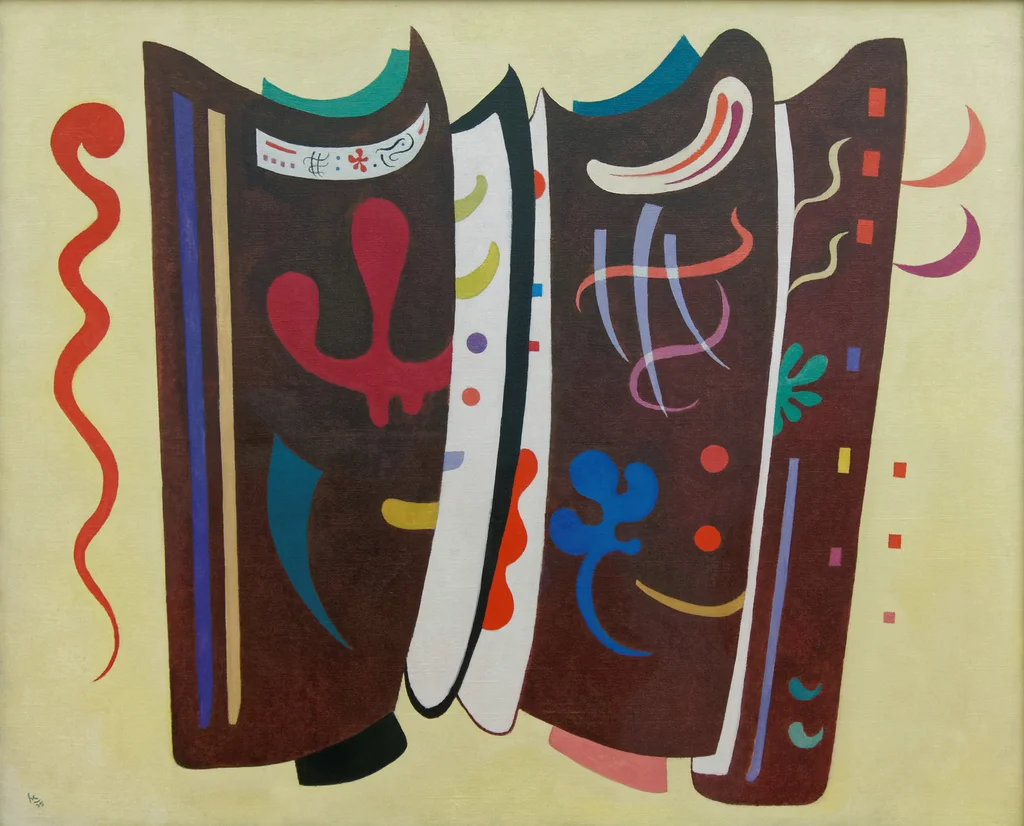
Wassily Kandinsky · PD
Brown with Supplement
Details
The story
By 1935 Kandinsky had been out of Germany for two years. The Bauhaus, where he taught, closed under Nazi pressure in 1933, and he was working now in an apartment at Neuilly-sur-Seine on the western edge of Paris, where the art world there paid him little attention. His steadiest buyer was in New York. On the advice of the painter Hilla Rebay, the American mining magnate Solomon Guggenheim had been acquiring Kandinskys since meeting him in Dessau in 1930, and he kept at it after 1937, when German museums were ordered to purge the artist's work as degenerate. This canvas belongs to those Paris years, when Kandinsky's forms turned soft and cellular, closer to plates in a biology book than to the hard geometry of his Bauhaus period. It reached Rotterdam in 1964, after the Guggenheim ran short of room and sent a group of pictures to auction, and the Boijmans bought eleven Kandinskys in a single purchase.