Wassily Kandinsky · PD
Capricious Forms
Details
The story
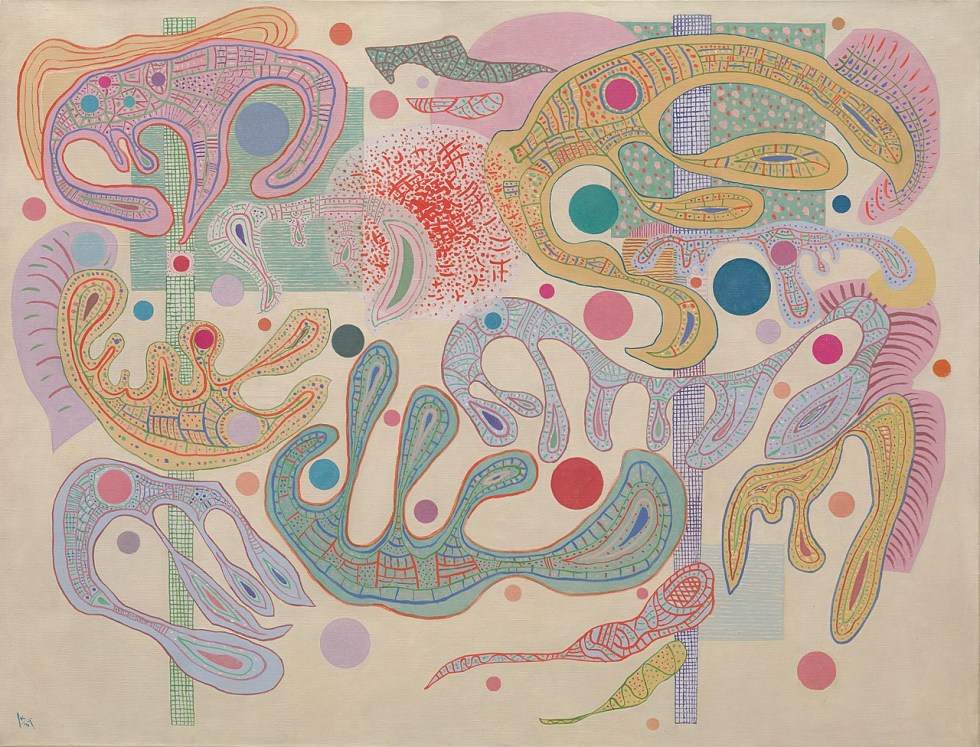
In 1926, while teaching at the Bauhaus, Kandinsky published a book of theory, Point and Line to Plane. One of its illustrations is a microscope photograph of a rat's loose connective tissue. Beside it he wrote that nature builds in two ways, with exact geometry like a spider's web and with free, loose lines, and that abstract painting uses both. He dated this canvas July 1937, 11 years later, in his flat at Neuilly-sur-Seine outside Paris, and here the two kinds sit side by side. Two tall strips of fine ruled grid, green at the left and violet at the right, stand behind everything. Over them drift soft shapes with trailing lobes, packed with tiny cells and dots. The Guggenheim reads some of them as embryos and others as close to textbook pictures of placental tissue, the kind Kandinsky collected from books on embryology and zoology. It is all painted thinly, in pinks, lavenders and sea greens.