Cayambe
Details
The story
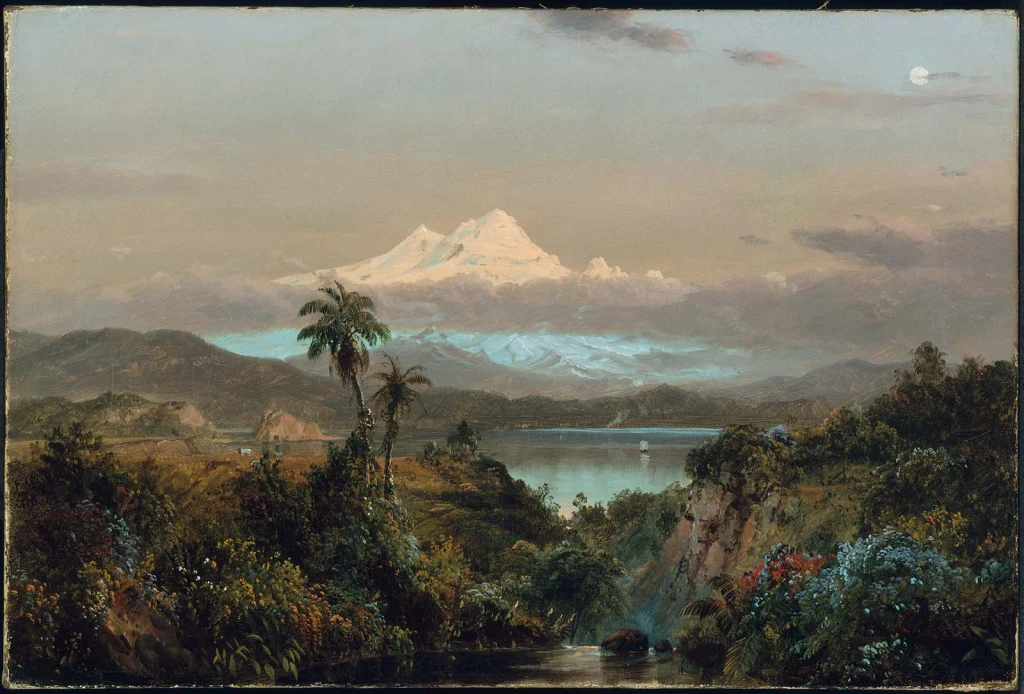
On 24 June 1857, on his second journey to Ecuador, Frederic Church sat drawing the volcano Cayambe in the morning and wrote notes beside it about snow lying on the lower summits and a beautiful bluish haze. The equator runs across the mountain's southern slopes, so its snow lies almost exactly on the line that divides the globe. In 1858, back in New York, he made this small canvas, about 30 by 46 centimetres. The Museum of Fine Arts thinks it may belong to the working out of a larger Cayambe that Church painted the same year for the New York sugar refiner Robert L. Stuart, which adds an ancient ruin for a patron who loved archaeology. This one keeps to the hour after sunset. A pale moon is up, the afterglow still catches the snow, and the blue Church noted on the spot comes back in the lake, in the flowers and in the mist rising from a hidden waterfall below the lagoon. Nobody knows who owned it first. It turned up on the New York market in the 1940s, and Maxim Karolik, a collector who prized oil sketches as much as finished pictures, bought it.