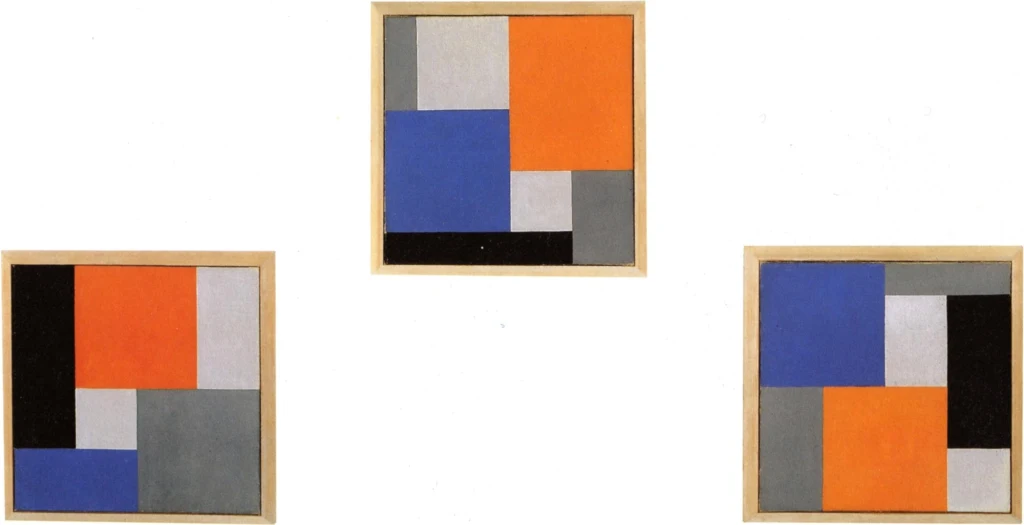
Composition XVIII in Three Parts
Details
The story
By 1920 the argument was settled, at least in his own mind. Three years earlier Theo van Doesburg had founded De Stijl, a Dutch movement that wanted painting stripped back to straight lines, right angles and the primary colours plus black, white and grey, and nothing else. This small square canvas, about 35 centimetres a side, is that programme carried out: the surface split into three parts, filled with rectangles of red, blue and yellow held in a scaffolding of grey and black. There is no subject, no horizon, no figure. The title does the work a description would, numbering it like a proposition in a series. He was painting these while also editing the magazine that told other artists why they should paint this way too.