Own work · CC-BY-4.0
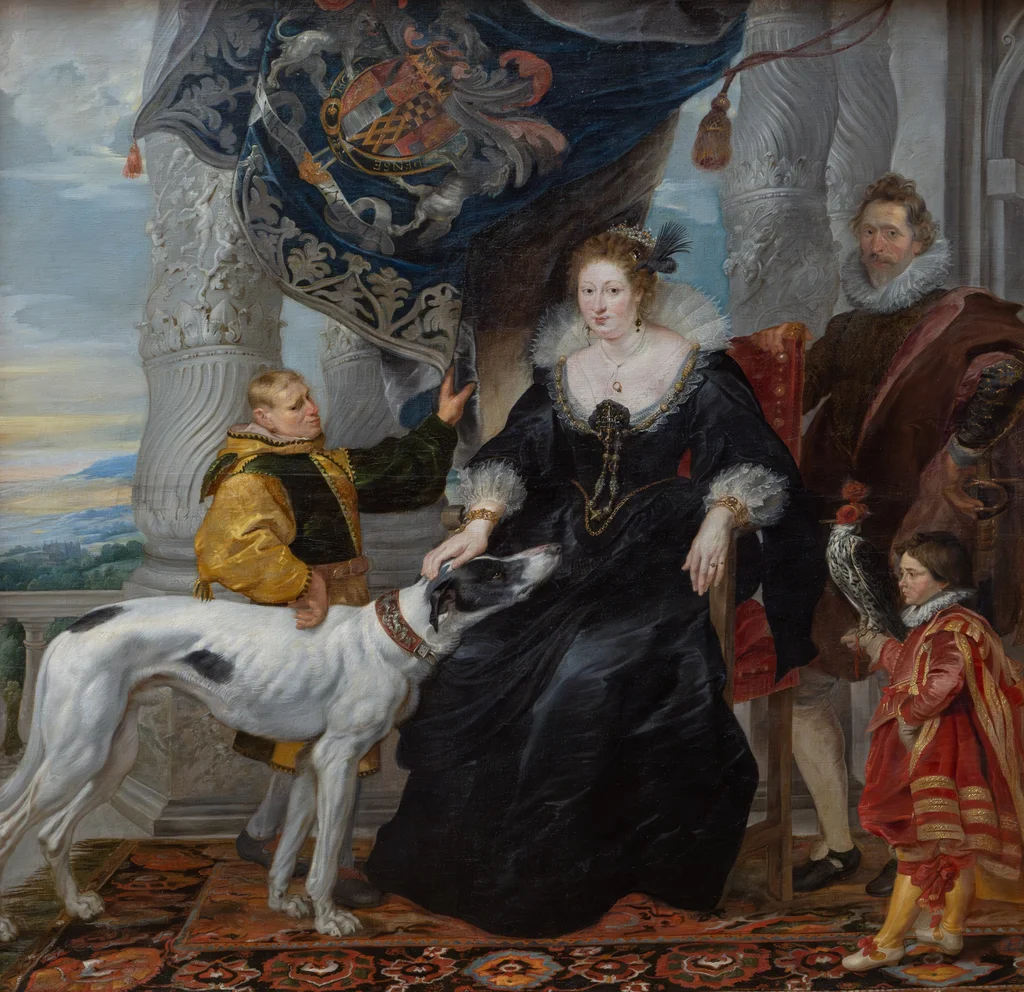
Double portrait of Alethea Talbot (1585-1654), Countess of Arundel and Sir Dudley Carleton (1573-1632), with two servants
Details
The story
In 1620 Alethea Talbot, Countess of Arundel, stopped in Antwerp on her way to Italy, and Rubens painted her, which he rarely did for anyone, since portraits were not really his trade. He worked fast, sketching the faces from life and jotting down the colours of the clothes to finish later. What he produced is enormous, well over two metres each way: the countess enthroned on a terrace among heavy columns, a hound at her side, a falcon nearby, both marks of a noble's right to hunt. Around her stand a jester and a dwarf. The man standing behind has never been settled. He is often called Sir Dudley Carleton, the English ambassador who a couple of years earlier had traded his collection of antique marbles to Rubens for paintings. Others think that figure was added later by another hand to stand in for her absent husband. The countess and her husband were the leading art collectors in England, which may be why Rubens made an exception for her at all.