Ecce Homo
Details
The story
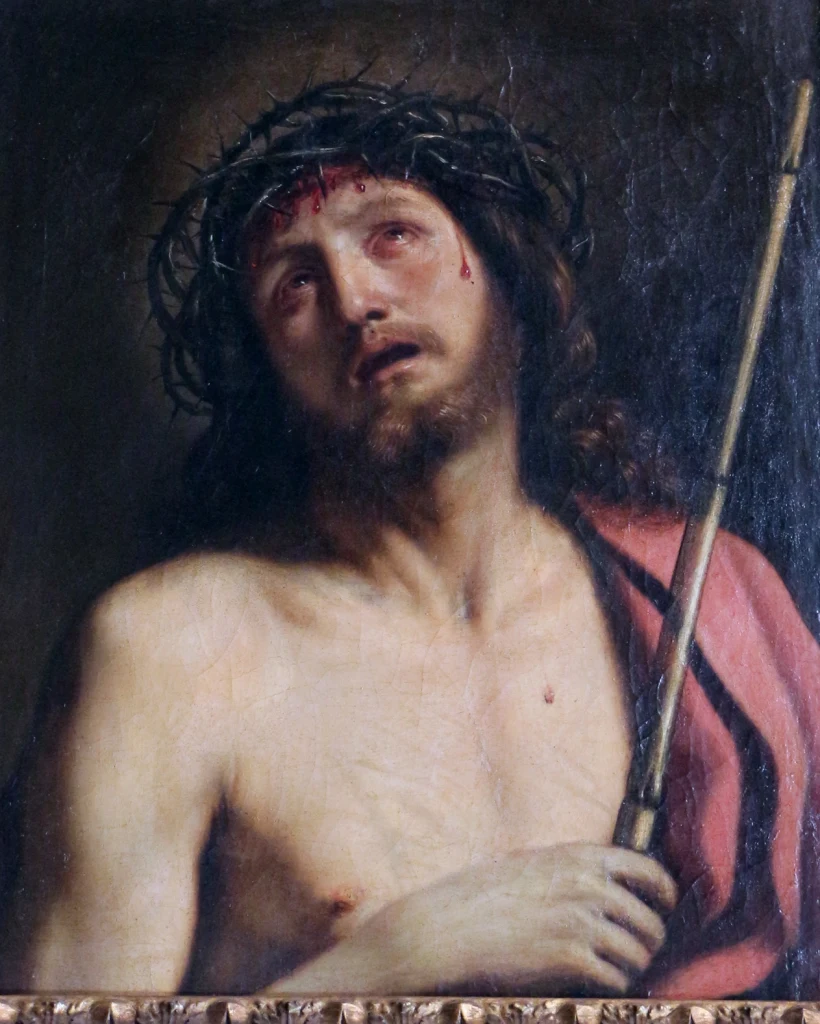
On 27 September 1642 Guercino left Cento, the small town where he had worked for most of his life, and moved to Bologna. A local diary of those years says his friend Count Filippo Aldrovandi pressed him to go, to get him away from the dangers of the War of Castro, which the family of Pope Urban VIII was then fighting against the Duke of Parma. Two years later, on 30 September 1644, his account book records 50 ducatoni paid by Giovanni Battista Tartaglioni of Modena for an Ecce Homo.
That entry is how this canvas is identified. Guercino charged mostly fixed prices by the number of figures, roughly 25 to 35 ducatoni for a single head and 40 to 60 for a half-length. Of the five times the book records the subject, this is the only half-length of Christ on his own.
The title is Pilate's phrase in the Gospel of John, behold the man, spoken as he shows the flogged Jesus to the crowd. Guercino leaves out Pilate and the crowd and keeps only Christ, in the purple robe and the crown of thorns. The museum points to how earthly he still looks, with beads of sweat between the nose and the eyes, the marks of the whip on his chest, light catching the drops of blood and the mouth half open.
By 1750 the picture was in the Corsini inventories, noted as coming from the estate of a cardinal of the Cibo family.